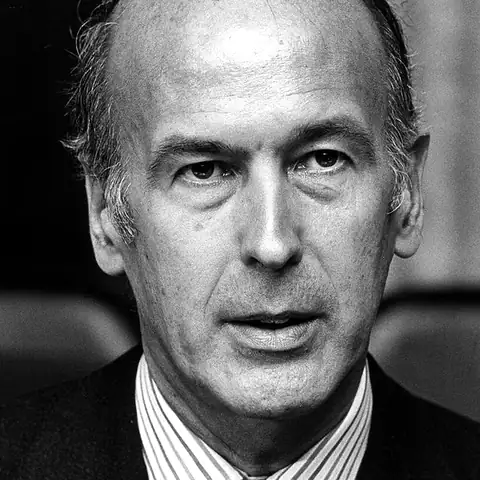
Who was Valéry Giscard d'Estaing?
Valéry Giscard d'Estaing came from the French elite. He served with the First Army at the end of the Second World War and took part in the liberation of Paris, then went to the École Polytechnique and the École Nationale d'Administration. A seat in the National Assembly came his way in 1956, and he later ran the finance ministry for both de Gaulle and Pompidou. When he spoke out against de Gaulle's 1969 referendum, he helped push the general to resign. At 48 he won the 1974 presidential election by a thin margin over François Mitterrand, and Mitterrand beat him in 1981. Later he led the Auvergne region, sat in the European Parliament and chaired the European Convention. He joined the Académie française in 2003 and died in 2020.
Political views
- His government brought the voting age down to 18.Source: elysee.fr
- His government legalized abortion and allowed divorce by mutual consent.Source: elysee.fr
- He widened the group of people who could send laws to the Constitutional Council for review.Source: elysee.fr
- He pushed for the European Council, which was set up at the Paris summit in December 1974.Source: en.wikipedia.org
- In 1975 he welcomed leaders to the Rambouillet summit, the meeting that gave rise to what became the G7.Source: en.wikipedia.org
- With Helmut Schmidt he built the European Monetary System, and at home he backed nuclear power and the TGV high-speed trains.Source: theguardian.com
- In 1978 he formed the UDF, a centre-right alliance of parties.Source: en.wikipedia.org
Legacy
To admirers, Giscard was a modernizer who gave the presidency a freer social tone in the years following de Gaulle and Pompidou and who laid the base for European money cooperation, a path that ended in the euro. Critics found him distant and grand. The oil shock of 1979 then brought high inflation and closed the era of fast postwar growth. He eased state control of public broadcasting and supported the Helsinki accords, yet French forces also fought in Chad, Zaire and Mauritania on his watch. He kept the death penalty. A 1979 report in Le Canard enchaîné said he had taken diamonds from Jean-Bédel Bokassa, the ruler of the Central African Republic, and the story hurt his bid for a second term. French voters turned down the EU constitution he helped write, in a 2005 referendum.