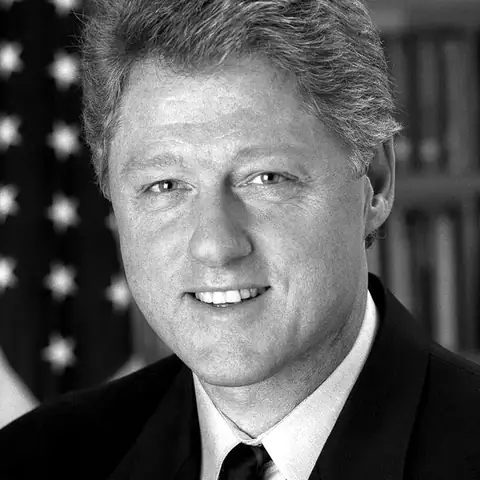
Who is Bill Clinton?
Bill Clinton was born in Hope, Arkansas, in 1946 with the name William Jefferson Blythe III. He studied at Georgetown, then Oxford, then Yale Law School. Back in Arkansas he served as attorney general and later as governor, first for two years from 1979 and then for nine more after a break, until 1992. He took the presidency in 1992 as a 'New Democrat' who wanted a Democratic Party closer to the middle ground, then won a second term in 1996. After leaving the White House he set up the Clinton Foundation, took a UN envoy role for Haiti and spoke at campaigns for Democrats.
Political views
- His 1993 budget raised taxes mostly on high earners and trimmed spending. By 1999 the federal books showed a surplus of $124 billion.Source: millercenter.org
- In 1996 he signed the welfare law he had promised, the one meant to 'end welfare as we know it'. It scrapped AFDC and sent block grants to each state.Source: millercenter.org
- A health plan for universal coverage, drawn up by a task force under Hillary Clinton, was dropped by Congress in 1994.Source: millercenter.org
- He signed the 1994 crime law, saying his party should stop feeling guilty about shielding the innocent.Source: en.wikipedia.org
- Congress passed NAFTA under him in 1993, followed by a revised GATT agreement in 1994.Source: millercenter.org
- He urged NATO to bomb Bosnian Serb forces, which led to the Dayton Accords, and he supported the 1999 air campaign against Serbian ethnic cleansing in Kosovo.Source: millercenter.org
- He supported NATO membership for the Czech Republic, Hungary and Poland.Source: millercenter.org
Legacy
Supporters credit Clinton with a long run of economic growth, budgets in surplus, a Democratic Party that could win from the centre, and peace efforts in Northern Ireland and the Balkans. On the left, critics say welfare reform, the 1994 crime law and looser financial rules hurt poor Americans and fed mass imprisonment and the 2008 crisis. Gay rights groups fought both the military policy known as Don't Ask, Don't Tell and the Defense of Marriage Act. Many also faulted his government for standing aside in the 1994 Rwandan genocide. He later apologised. In December 1998 the House impeached him for perjury and obstruction linked to the Monica Lewinsky affair. The Senate voted to acquit in February 1999.