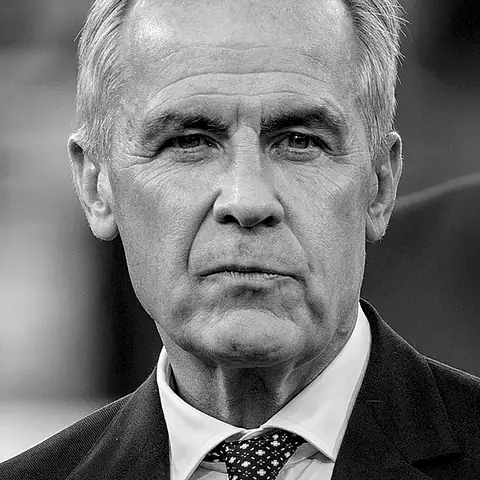
Who is Mark Carney?
Mark Carney was born in Fort Smith, Northwest Territories, in 1965 and raised in Edmonton. He studied economics at Harvard and Oxford and worked at Goldman Sachs before joining the Bank of Canada and the federal Department of Finance. He was Governor of the Bank of Canada from 2008 to 2013, including during the global financial crisis, and Governor of the Bank of England from 2013 to 2020. He later served as UN Special Envoy for Climate Action and Finance. He won the Liberal leadership in March 2025 without having held elected office, was sworn in as Prime Minister, and led the party to a minority win in the April 2025 election, becoming MP for Nepean. His Liberals reached a majority in April 2026 after five opposition MPs crossed the floor and the party won three by-elections on 13 April.
Previously: Leader of the Liberal Party of Canada (since March 2025) · UN Special Envoy for Climate Action and Finance (2019-2025) · Governor of the Bank of England (2013-2020) · Governor of the Bank of Canada (2008-2013)
Documented positions
- Cancelled the planned increase to the capital gains inclusion rate in March 2025, citing support for entrepreneurs and private investment.Source: pm.gc.ca
- Ended the consumer carbon tax by order in council on his first day as Prime Minister in March 2025, leaving industrial carbon pricing in place.Source: cbc.ca
- His government's One Canadian Economy Act, which passed the House of Commons in June 2025, aims to remove federal barriers to internal trade and speed up approval of major projects.Source: pm.gc.ca
- Set lower immigration levels, with targets of 380,000 permanent and 385,000 new temporary admissions in 2026 and a goal of temporary residents below 5 percent of the population by the end of 2027.Source: canada.ca
- Announced in July 2025 that Canada intended to recognise the State of Palestine in September 2025, predicated on Palestinian Authority reforms, demilitarisation and 2026 elections that exclude Hamas.Source: pm.gc.ca
- Argues that middle powers should act together, citing new strategic partnerships with the EU, China and Qatar and a plan to double defence spending by the end of the decade.Source: pm.gc.ca
- Presented a November 2025 budget with a projected 2025-26 deficit of 78.3 billion dollars, pairing new capital spending with planned savings.Source: globalnews.ca
Record
Carney's government has focused on the trade dispute with the United States, internal trade, major energy and infrastructure projects and lower immigration levels. In November 2025 it signed a memorandum of understanding with Alberta that lays groundwork for a new oil pipeline, and former environment minister Steven Guilbeault resigned from cabinet the same day in opposition to the agreement. On 22 August 2026 the United States imposed 50 percent tariffs on about 20 billion dollars of Canadian goods after talks failed, and Carney announced retaliatory tariffs from 8 September. In October 2026 he welcomed the result of Alberta's referendum, in which voters rejected starting a process toward separation.
Supporters cite the end of the consumer carbon tax, faster project approvals, trade diversification and higher defence spending. Critics on the left cite the pipeline agreement and changes to climate policy, while critics on the right cite the size of the deficit and the floor crossings that produced a majority.
In their words
“We are in the midst of a rupture, not a transition.”