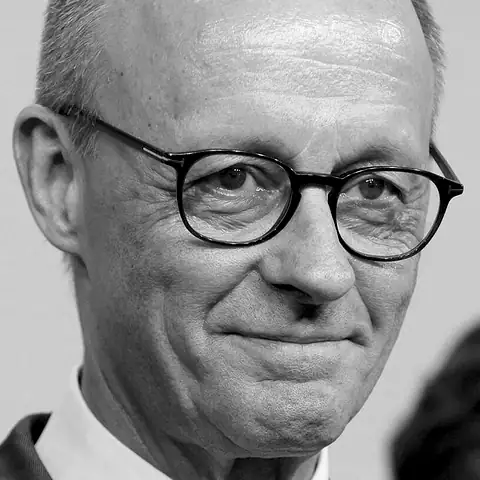
Who is Friedrich Merz?
Friedrich Merz was born in Brilon in 1955 and trained as a lawyer, briefly serving as a judge. He sat in the European Parliament from 1989 and in the Bundestag from 1994 to 2009, leading the CDU/CSU group from 2000 to 2002. He then worked in business law before returning to the Bundestag in 2021. He became CDU chair in 2022, led the Union to first place in the February 2025 election and was elected Chancellor on 6 May 2025 in a second ballot, at the head of a coalition with the SPD.
Previously: Chair of the Christian Democratic Union (since 2022) · Chair of the CDU/CSU parliamentary group (2000-2002, 2022-2025) · Member of the Bundestag (1994-2009, since 2021) · Member of the European Parliament (1989-1994)
Documented positions
- Supported the March 2025 constitutional change that exempted defence spending above 1 percent of GDP from the debt brake and created a 500 billion euro infrastructure fund.Source: wlrn.org
- In January 2025 tabled a non-binding motion for stricter border and migration rules that passed 348 to 345 with AfD support.Source: nbcnews.com
- Voted in March 2026 for replacing the Bürgergeld with a new Grundsicherung that has stricter work requirements and sanctions.Source: abgeordnetenwatch.de
- Voted in December 2025 for the military service law that reintroduces compulsory screening for men born from 2008 while keeping service voluntary for now.Source: abgeordnetenwatch.de
- Voted for the 2025 pension package that keeps the pension level at 48 percent through 2031 and extends credits for child-rearing.Source: abgeordnetenwatch.de
- Voted in February 2026 for the law implementing the EU asylum reform, including border procedures at airports and seaports.Source: abgeordnetenwatch.de
- Urged EU partners, during his first foreign visit as Chancellor to Paris in May 2025, to ratify the EU-Mercosur trade agreement quickly; its trade part took provisional effect on 1 May 2026.Source: batimes.com.ar
- Backed using frozen Russian assets to fund a reparations loan for Ukraine in December 2025, saying he saw no better option.Source: pravda.com.ua
Record
Merz's government passed the defence and infrastructure financing package, a military service law, a pension package and the Grundsicherung reform. Interior Minister Alexander Dobrindt ordered rejections of asylum seekers at the border in May 2025; a Berlin administrative court ruled in June 2025 in urgent proceedings that three such rejections were unlawful, and the government kept the policy. Supporters cite higher defence investment and tighter migration rules as delivered promises.
Critics point to falling approval ratings and to the July 2026 reshuffle, in which Thorsten Frei replaced Jens Spahn as group leader, Nina Warken moved to the Chancellery and Carsten Linnemann became health minister. In September 2026 state elections the AfD won in Mecklenburg-Western Pomerania, where the CDU fell to 4.9 percent, and Die Linke finished ahead of the CDU in Berlin. Merz called the result a disaster and said he would keep the coalition together.
In their words
“whatever it takes must also go for our defense now”