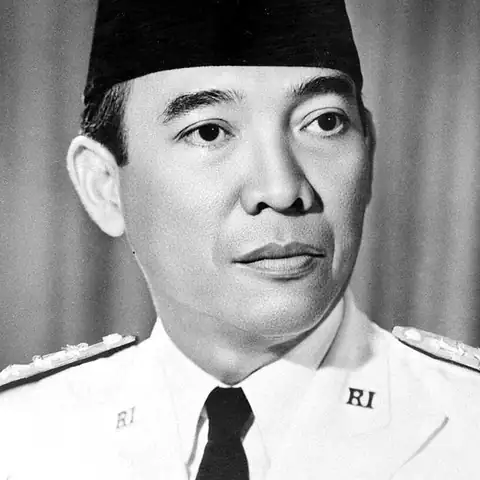
Who was Sukarno?
Sukarno was born in Surabaya in 1901 and trained as an engineer in Bandung. In 1927 he founded the Indonesian Nationalist Party, and the Dutch jailed and exiled him in the 1930s. In June 1945 he set out the Pancasila, five principles for the new state, and on 17 August 1945 he proclaimed independence and became president. Parliamentary rule gave way in 1959 to Guided Democracy under the 1945 Constitution, which gave the president sweeping power. He lost authority after the events of 30 September 1965, was sidelined by General Suharto and died under house arrest in 1970.
Political views
- Set out Pancasila in June 1945: belief in one supreme God, justice and civility among peoples, Indonesian unity, democracy through deliberation and social justice.Source: indonesia-investments.com
- Argued in the 1920s that Islam and communism were not incompatible, an idea he later formalized as Nasakom, a union of nationalism, religion and communism.Source: encyclopedia.com
- Blamed the country's troubles on Western-style democracy and proposed Guided Democracy, with decisions by consensus rather than majority vote.Source: ebsco.com
- In 1959 reinstated the 1945 Constitution, dissolved the elected parliament and banned the Masjumi and PSI parties.Source: encyclopedia.com
- Pursued control of western New Guinea and, from 1962 to 1966, a Confrontation with Malaysia that he called a continuation of colonialism.Source: indonesia-investments.com
- Balanced the army against the Indonesian Communist Party and relied more on Soviet and Chinese aid, which strengthened the party.Source: ebsco.com
- Withdrew Indonesia from the IMF and World Bank in 1965 and from the United Nations when Malaysia was admitted.Source: indonesia-investments.com
Legacy
Indonesians honor Sukarno as the voice of independence who united a vast archipelago of diverse peoples around Pancasila. Admirers also credit his anti-colonial campaigns, including the transfer of western New Guinea to Indonesia. Critics fault his turn to Guided Democracy, which ended elected parliamentary government, and an economy that had reached extremely precarious levels by 1965. After the 30 September 1965 killings of six generals, an anti-communist purge followed in which estimates of the dead run from 100,000 to 1 million, while Sukarno himself was never charged but was sidelined by Suharto and held under house arrest until his death.