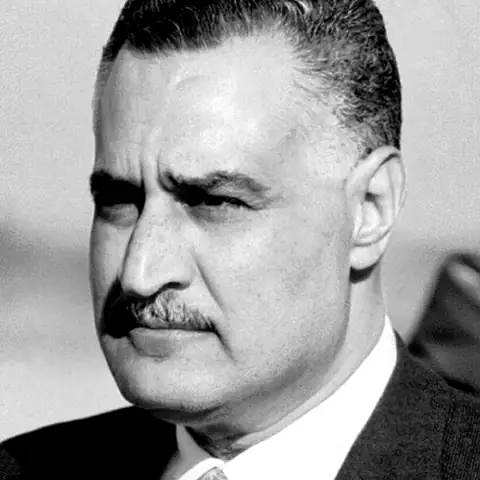
Who was Gamal Abdel Nasser?
Gamal Abdel Nasser was born in Alexandria in 1918, the son of a postal worker, and graduated from the Royal Military Academy in 1938. With the secret Free Officers he overthrew King Farouk on 23 July 1952. By 1954 he had pushed aside General Neguib, banned parties and secured the withdrawal of British troops. After his 1956 election as president he nationalized the Suez Canal, survived the British-French-Israeli attack and led a short union with Syria. Egypt's defeat in the 1967 war damaged his standing, and he died of a heart attack on 28 September 1970.
Political views
- Led the July 1952 Free Officers coup, after which land holdings over 200 acres were confiscated and redistributed. Ceilings were cut later in 1961 and 1969.Source: ebsco.com
- Banned political parties in 1954, kept that ban under the 1956 constitution, and renamed the National Union the Arab Socialist Union in 1962.Source: ebsco.com
- Nationalized the Suez Canal Company on 26 July 1956 and offered it full compensation. Britain, France and Israel attacked Egypt that autumn.Source: history.state.gov
- Censored most of the press and nationalized it in 1960. Banks and utilities were nationalized later to finance industrialization under Arab socialism.Source: ebsco.com
- Promoted nonalignment at the 1955 Bandung Conference, and formed the United Arab Republic with Syria in 1958, which broke up in 1961.Source: jewishvirtuallibrary.org
- Ruled out Western aid for the Aswan High Dam because of his anti-Western stance, took a $300 million Soviet loan, and sent troops into the Yemen war from October 1962.Source: ebsco.com
Legacy
Admirers across the Arab world credit Nasser with ending British control, redistributing land, building the Aswan High Dam and challenging foreign domination, though only about one in five peasants who needed land received it. Critics describe his rule as a police state in which parties were banned, the press was censored, and groups such as the Muslim Brotherhood were broken up. They also fault the costly Yemen war, his reliance on Soviet backing and the 1967 defeat, in which Israel took Sinai, Gaza, the West Bank and the Golan Heights. He left Egypt in poor financial condition after the wars.