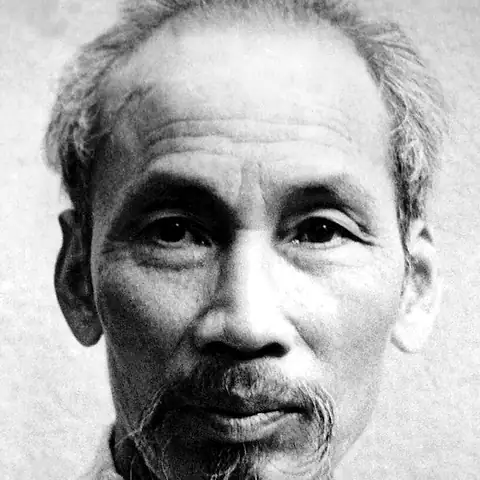
Who was Hồ Chí Minh?
Hồ Chí Minh was born around 1890 in Nghệ An, central Vietnam. He left for France in 1911, became a founding member of the French Communist Party in 1920, and later worked for the Comintern in Moscow. He helped found the Indochinese Communist Party in 1930. Returning to Vietnam in 1941, he led the Viet Minh, which took power in the August Revolution of 1945. On 2 September that year he read the Declaration of Independence in Hanoi. He remained president of the Democratic Republic of Vietnam through the wars with France and the United States until he died in 1969.
Political views
- In 1919 he tried to present a proposal for Vietnamese independence to Woodrow Wilson at Versailles but was turned away.Source: countrystudies.us
- He was strongly influenced by Lenin's Theses on the National and Colonial Questions and became a founding member of the French Communist Party in 1920.Source: countrystudies.us
- The party founded in February 1930 under his guidance called for independence, a workers' and peasants' government, land redistribution and an eight-hour workday.Source: countrystudies.us
- His 1945 Declaration of Independence quotes the American and French declarations of rights and argues that more than eighty years of French rule had been unjust.Source: marxists.org
- In late 1945, with Chinese Nationalist troops in the north, he ordered Viet Minh forces to avoid clashes and agreed to share power with nationalist parties.Source: countrystudies.us
- In March 1946 he signed an accord recognizing the republic as a free state within the French Union. Many Vietnamese saw this as a betrayal of the revolution.Source: countrystudies.us
- Cooperatives began in the North in 1959 and 1960, and by 1965 about 90 percent of peasant households were in collectives.Source: countrystudies.us
Legacy
Vietnamese admire Hồ as the father of national independence, and the 'Uncle Ho' image became central to political culture. Supporters credit him with uniting nationalist and social aims against colonial rule. Critics note that he built a Leninist one-party state, that his government's land reform of 1953-1956 caused many executions before the party admitted serious mistakes, and that collectivization and decades of war imposed heavy costs. Historians still dispute how far he steered these events. He asked to be cremated, but his body was embalmed and placed in a mausoleum in Hanoi.