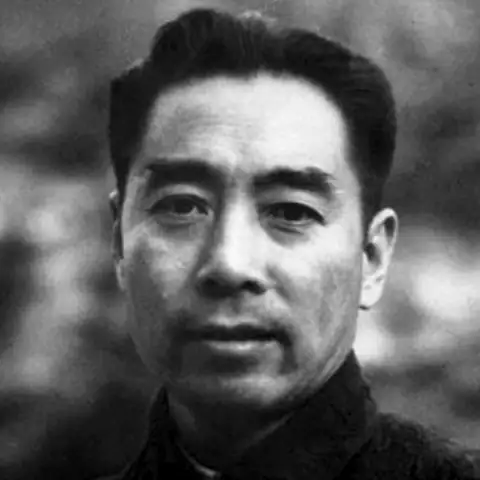
Who was Zhou Enlai?
Zhou Enlai was born in Jiangsu province in 1898 and turned to Marxism after the 1917 Russian revolution. He joined the Chinese Communist Party in Europe in the 1920s and became a senior negotiator, including in the 1936 talks that brought Chiang Kai-shek into a united front against Japan. From the founding of the People's Republic in 1949 he was premier until his death, and he was foreign minister until 1958. He died of cancer in January 1976, eight months before Mao. His ashes were scattered, with no monument.
Political views
- Turned to Marxism after the 1917 Russian revolution and spent his working life in the Chinese Communist Party.Source: encyclopedia.com
- Acted as a practical diplomat and moderate rather than an ideologue, and tried to restrain extremists inside the party.Source: encyclopedia.com
- During the Cultural Revolution he quietly protected some moderate leaders, though he could not stop the purges. Red Guards tortured one of his adopted daughters to death.Source: encyclopedia.com
- Pushed the Four Modernizations in 1975 to repair the damage of the late Cultural Revolution.Source: newworldencyclopedia.org
- Warned the United States against advancing in North Korea in 1950, then sent Chinese troops into the war.Source: encyclopedia.com
- Led China's delegation to the 1955 Bandung Conference of Asian and African states.Source: newworldencyclopedia.org
- Told Nixon in 1972, with Mao, that China would not normalize relations while Washington kept formal ties with Taiwan.Source: history.state.gov
Legacy
Admirers remember Zhou as the steady hand of Mao's China, a skilled negotiator who ran the state, reached out to the developing world and brought about the opening to the United States. Many credit him with sheltering colleagues and cultural sites during the Cultural Revolution. Critics note that he served Mao through campaigns such as the Great Leap and the Cultural Revolution, and that he stayed in office and kept his criticism quiet. He backed the intervention in the Korean War and a hard line on Taiwan. His death in 1976 prompted public mourning that fed the April Tiananmen protests, and Deng Xiaoping, a Zhou supporter, later rose to lead the country.