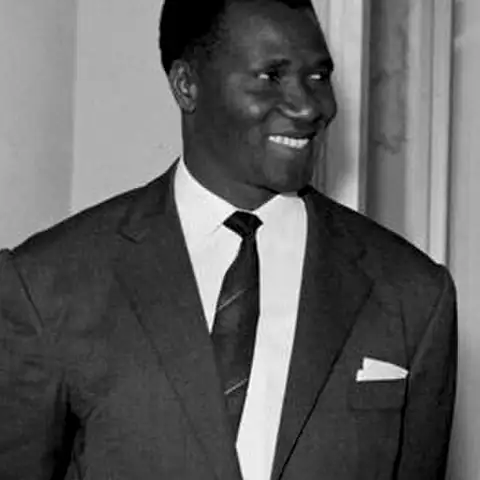
Who was Ahmed Sékou Touré?
Touré was born in 1922 in Faranah, in a Malinke peasant family. He became a union organizer, joined the Democratic Party of Guinea and became its secretary-general in 1952. He was mayor of Conakry from 1955 and won a seat in the French National Assembly in 1956. In 1958 he urged a No vote on de Gaulle's French Community, and Guinea became the only French African territory to reject it. He was president from 1958 until his death in 1984, ruling as a one-party state, and he died in a Cleveland hospital.
Political views
- In the 1958 referendum he urged a No vote on de Gaulle's French Community, and about 95 percent of voters agreed.Source: ebsco.com
- Export trade was nationalized in 1959 and internal trade in 1960, and in 1960 Guinea created its own currency and took control of banking and insurance.Source: ebsco.com
- At the 1967 party congress socialism became the official goal, and society was described as divided into the people and the antipeople.Source: ebsco.com
- After 1964 the party became a stricter cadre party reaching into factories, the army and the civil service, and in 1978 he declared a one-party state.Source: ebsco.com
- The regime lived in a state of plots: nine major plots were exposed between 1960 and 1976, each followed by crackdowns on dissenters.Source: ebsco.com
- After a 1971 Portuguese-backed mercenary attack, thousands were arrested and dozens were hanged, including former ministers.Source: ebsco.com
- Camp Boiro held thousands of intellectuals, critics and perceived rivals, who were tortured and killed there.Source: hrw.org
- Abroad he stressed African unity, anti-imperialism and nonalignment, and signed the Ghana-Guinea Union with Kwame Nkrumah in 1958.Source: ebsco.com
Legacy
Admirers credit Touré with leading Guinea to independence in 1958 by saying No to France, with backing African liberation movements and with pan-African unity. Critics charge that his government became a one-party dictatorship that suppressed expression and opposition, ran Camp Boiro, where thousands were tortured and killed, and drove thousands of intellectuals into exile. Human Rights Watch cites estimates of as many as one million Guineans fleeing the country. His last decade saw less diplomatic isolation, but the fear and distrust left by his rule lasted well beyond 1984.