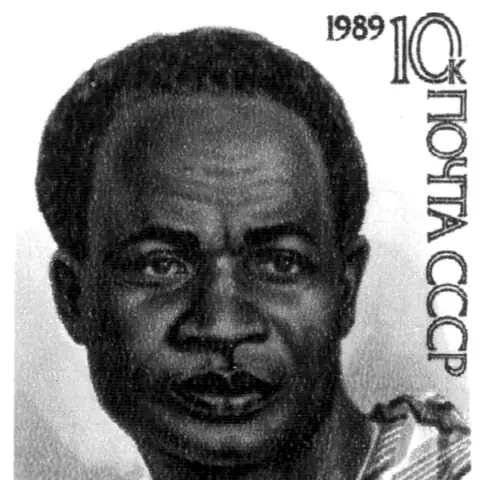
Who was Kwame Nkrumah?
The Gold Coast village of Nkroful was Kwame Nkrumah's birthplace, in 1909. He studied in the United States and then spent time in London. In 1949 he started his own party, the Convention People's Party, and three years later he was running the colonial government as prime minister. Ghana became independent under him in 1957, one of the first African countries to break free. As president from 1960 he paid for state industry and the Volta River dam, while his rule grew harsher. Soldiers overthrew him in 1966 as he traveled abroad. He spent his last years in exile in Guinea and died in Bucharest in 1972.
Political views
- He believed African problems needed African answers, and that the continent would only be strong under one political union.Source: marxists.org
- He wanted the continent's mineral wealth and water power developed by joint planning across Africa, not handed over to foreign investors.Source: marxists.org
- He warned that a country could be independent on paper while outsiders still controlled its economy, and he named this neo-colonialism.Source: marxists.org
- He denied that traditional Africa had been free of classes, and he called for the main means of production to be owned in common, following scientific socialism.Source: marxists.org
- The 1958 Preventive Detention Act allowed the state to hold people without trial for as long as five years.Source: en.wikipedia.org
- By the official count of a 1964 referendum, 99.91 percent voted to make the Convention People's Party the sole legal party.Source: en.wikipedia.org
Legacy
Many people honor Nkrumah as a giant of African freedom and pan-Africanism. Listeners to the BBC World Service picked him as Africa's Man of the Millennium in 2000. Admirers point to more schools, big projects like the Akosombo dam, and his part in creating the Organisation of African Unity. Critics start with the Preventive Detention Act, which his biographer David Birmingham thought did more harm to his name than anything else. They add the one-party state, a 1964 referendum that was plainly rigged, and a personality cult built on the title Osagyefo. Heavy borrowing, steep levies on cocoa growers and a crash in cocoa prices left Ghana indebted and cost him rural support. Claims that the CIA took part in the 1966 coup have never been fully verified.
In their own words
“Divided we are weak; united, Africa could become one of the greatest forces for good in the world.”