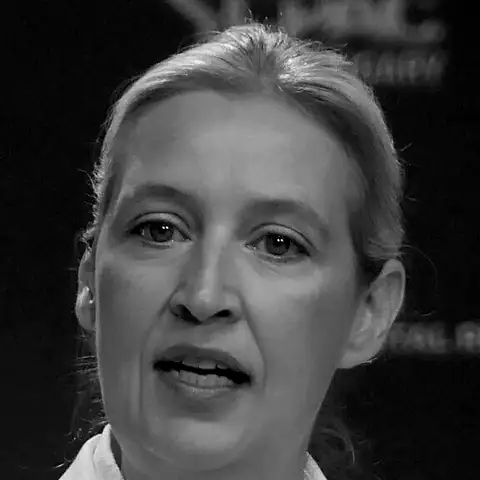
Who is Alice Weidel?
Weidel, born in 1979 in Gütersloh, holds a doctorate in economics. Her earlier career was in finance and business, including years in China. After winning a Bundestag seat in 2017 she became one of the AfD group's two leaders. Tino Chrupalla joined her as party co-chair in June 2022. The party put her forward for Chancellor in the 2025 federal election. Delegates at the July 2026 congress in Erfurt returned her to the co-chair post with 81.3 percent.
Previously: Co-leader of the AfD Bundestag group (since 2017), the largest opposition group since May 2025 · AfD candidate for Chancellor (2025 federal election) · Member of the Bundestag for Baden-Württemberg (since 2017)
Documented positions
- Speaking in January 2025, she said an AfD government would withdraw from the shared EU asylum system, dismantle wind turbines and bring working nuclear plants back online.Source: zdfheute.de
- The 2025 programme named remigration as a goal, and she backed it. The AfD defines it as deporting those who must leave and sending refugees back once the reasons for their protection end.Source: stuttgarter-zeitung.de
- Her March 2026 vote went against rejecting an AfD motion demanding eight years of residence before a person can be naturalised.Source: abgeordnetenwatch.de
- An AfD motion opposing a windfall tax, and calling for lower fuel taxes and scrapping the CO2 levy, was up for rejection in April 2026. She voted against that rejection.Source: abgeordnetenwatch.de
- She opposed the Grundsicherung law of March 2026, which took the place of the Bürgergeld.Source: abgeordnetenwatch.de
- In July 2026 she voted no on a motion from the Greens to give Ukraine more military and humanitarian backing.Source: abgeordnetenwatch.de
- Both the December 2025 military service law and the government's pension package, voted on that same day, met her opposition.Source: abgeordnetenwatch.de
Record
The domestic intelligence agency (the Federal Office for the Protection of the Constitution) labelled the AfD a confirmed right-wing extremist effort in May 2025. The party had already lost a case on a lesser label: the Higher Administrative Court in Münster upheld the suspected-case classification in May 2024, and that ruling became final when the Federal Administrative Court turned down the AfD's appeal in May 2025. Then, on 26 February 2026, the Cologne Administrative Court agreed to the party's urgent request. The agency is barred from applying the confirmed extremist label while the main case is pending. Even so, the judges saw a strong suspicion that the party pursues anti-constitutional aims, so it remains a suspected case. Weidel posted on X that the ruling had indirectly blocked a ban on the party. The Federal Interior Ministry said in March 2026 that it would leave the interim decision unchallenged and argue its position in the main proceedings.
Saxony-Anhalt and Mecklenburg-Western Pomerania held state elections in September 2026, and the AfD placed first in both. Its backers cite its emphasis on migration, energy prices and sovereignty. Its critics cite the intelligence assessments, as well as its stances on migrants and Russia.
In their words
“Wir werden rigoros abschieben!”