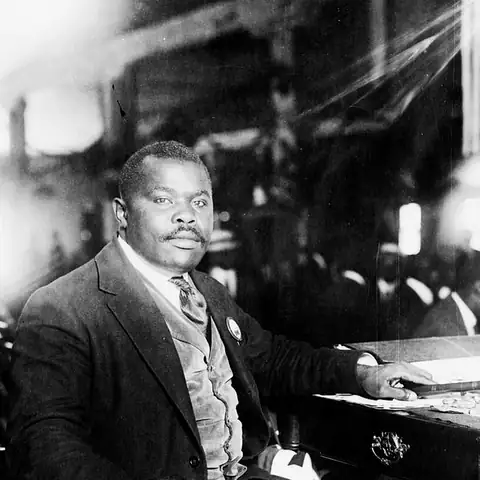
Who was Marcus Garvey?
Marcus Garvey was born on 17 August 1887 in Saint Ann's Bay, Jamaica. He worked in several Latin American countries, then lived in London and studied at Birkbeck College. He founded the Universal Negro Improvement Association in Jamaica in July 1914 and started a New York branch in 1916. In 1919 the group launched the Black Star Line, a Black-owned shipping company. Federal prosecutors indicted him for mail fraud in 1922, he was convicted in 1923, and he served time in the Atlanta penitentiary until his sentence was commuted. He was deported to Jamaica in 1927 and died in 1940.
Political views
- He held that the races would do best if kept separate and self-sufficient, rejecting both black supremacy and integration.Source: encyclopedia.com
- Through the UNIA he led a back-to-Africa movement and launched the Black Star Line to link Black communities in the Americas, the Caribbean and Africa.Source: forms.international.ucla.edu
- He supported Black-owned restaurants and shopping centers to encourage economic independence.Source: archives.gov
- In 1920 he announced a Liberian Colonization Plan and sent technicians to Liberia in 1921, but the effort failed.Source: pku-jri.ucla.edu
- In June 1922 he met the acting Imperial Wizard of the Ku Klux Klan, arguing that the UNIA and the Klan shared a policy of racial separation, which caused outrage and a split in his organization.Source: encyclopedia.com
- He feuded bitterly with W.E.B. Du Bois, who opposed him.Source: encyclopedia.com
- His weekly Negro World carried his message of racial pride across the world, and some governments in Africa and the Caribbean banned it.Source: forms.international.ucla.edu
Legacy
Admirers see Garvey as the leader of the largest organized mass movement in Black history and the progenitor of modern Black pride. His ideas shaped Pan-Africanism, the Black Power movement and Rastafari, and Jamaica named him a national hero in 1964. Critics say the Black Star Line sank through mismanagement and corruption, that his Klan meeting betrayed other Black leaders, and that his separatism played into segregationist arguments. Historians still disagree on whether he committed fraud himself, but a court convicted him of mail fraud, and a presidential commutation freed him before deportation.