12axes-testTake the test
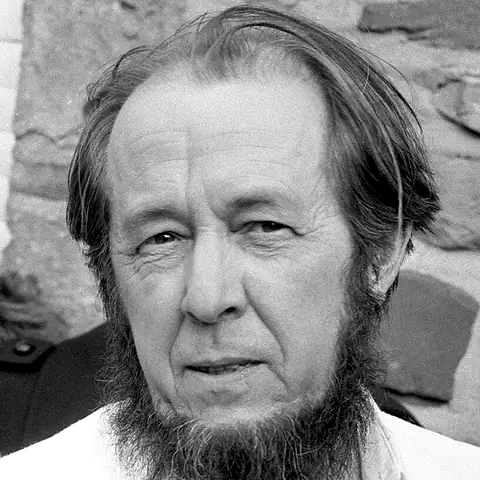
Aleksandr Solzhenitsyn
Historical figureRussia1918-2008

Aleksandr Solzhenitsyn

Novelist and historian, author of The Gulag Archipelago · Soviet dissident and former Gulag prisoner

Russian writer who survived the Gulag and told the world about it, then turned on Western materialism and argued for faith, local self-rule and a Russian national revival.

Profile on 12 axes10 of 12 documented
ECONOMYSTATESOCIETYWORLDOwnershipMarketsWelfareAuthoritySecurityStructureMoralityReligionTechnologyCultureTradeForeign
Where they stood

Aleksandr Solzhenitsyn, axis by axis

  1. PublicPrivate

    Saw socialism as damaging to the human spirit, yet disliked the unfair gains of the post-Soviet sell-off. His score leans only a little toward private ownership.

  2. PlannedFree
  3. 03WelfareNo clear record
    SharedSelf-reliant
  4. DemocraticStrong leader

    He suffered in the Gulag and exposed Soviet repression. Even so, he doubted that Western-style democracy would suit Russia, attacked Yeltsin and spoke well of Putin in old age. His score leans slightly toward strong leadership.

  5. LibertyOrder
  6. LocalCentral

    Often called for local self-rule and pointed to New England town meetings and Swiss cantons as examples.

  7. ProgressiveTraditional
  8. SecularReligious
  9. EmbraceCaution

    Distrusted materialism and the Western belief in progress and consumption, so he scores a little toward caution. He wrote little about specific technologies.

  10. MulticulturalNational identity
  11. 11TradeNo clear record
    GlobalProtected
  12. CooperationStrength

    Backed the Vietnam War, called the Paris Peace Accords a rushed surrender, and later opposed NATO's move east and the bombing of Yugoslavia.

2 axes have no clear record, so matching leaves them out.

Who was Aleksandr Solzhenitsyn?

Aleksandr Solzhenitsyn was a Russian writer born in 1918. He studied mathematics and fought as an artillery officer in the Second World War. In 1945 he was arrested for criticizing Stalin in private letters and served eight years in labor camps, then lived in internal exile. His 1962 novel about camp life brought him fame. In 1970 he was awarded the Nobel Prize in Literature. After The Gulag Archipelago was printed in the West, the Soviet state expelled him in 1974. He lived in the United States until 1994, then went home to Russia. He died near Moscow in 2008.

Political views

  • Called on Soviet citizens to bring down the regime by refusing to repeat or support its lies.Source: solzhenitsyncenter.org
  • Argued at Harvard in 1978 that Western societies had lost courage, leaned too heavily on legal rules and lacked spiritual depth.Source: solzhenitsyncenter.org
  • Said socialism was no answer, but also would not hold up the Western system as a model for Russia.Source: solzhenitsyncenter.org
  • Blamed the West's troubles on a humanism that left God out, and wanted spiritual renewal to count for more than material growth.Source: solzhenitsyncenter.org
  • Suggested in 1990 that the non-Slavic republics be allowed to leave the USSR, with Russia, Ukraine, Belarus and part of Kazakhstan joined in one state.Source: en.wikipedia.org
  • Backed strong local self-government and a mild, moderate patriotism, and attacked the oligarchs who profited in 1990s Russia.Source: en.wikipedia.org

Legacy

Admirers credit Solzhenitsyn with showing the world how the Soviet camp system worked. The Gulag Archipelago sold in huge numbers and changed how many in the West saw communism. The Nobel committee praised the moral force of his writing. His later opinions split his audience. Religious and conservative readers liked his attack on secular materialism. Liberals disliked his Russian nationalism and his Orthodox faith. He described a separate Ukrainian nation as a recent invention. Historians such as Laura Engelstein have called his book Two Hundred Years Together antisemitic. Some scholars also dispute the methods and numbers in the Gulag book. Vladimir Putin praised him as a patriot and opened a monument to him in 2018.

In their own words

“A decline in courage may be the most striking feature that an outside observer notices in the West today.”
A World Split Apart, commencement address at Harvard University, 1978
“No, I could not recommend your society as an ideal for the transformation of ours.”
A World Split Apart, commencement address at Harvard University, 1978

How close are you to Aleksandr Solzhenitsyn?

Take the 12 Axes test and see which historical figure is your political twin, axis by axis.

Take the test

Aleksandr Solzhenitsyn: questions

Was Solzhenitsyn left or right?

He is usually seen as a religious, nationalist conservative. He fought communism but was no fan of Western liberalism either, and he wanted Orthodox faith and local self-government at the centre of public life.

What was Solzhenitsyn's Gulag Archipelago about?

It is his history of the Soviet camp system, built on his own years as a prisoner and on accounts from many other survivors. It came out abroad in 1973.

Why did the USSR expel Solzhenitsyn?

The Gulag book appeared in Paris in 1973. The authorities then arrested him, took away his citizenship and sent him to West Germany in February 1974.

Sources