12axes-testTake the test
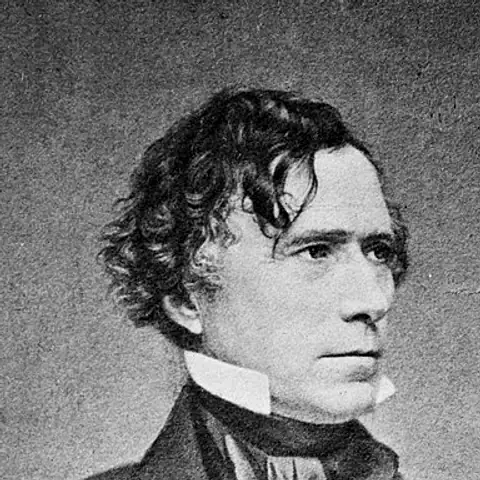
Franklin Pierce
Historical figureUnited States1804-1869

Franklin Pierce

14th President of the United States (1853-1857) · U.S. Senator from New Hampshire

Democrat from New Hampshire who served as president from 1853 to 1857. His backing of the Kansas-Nebraska Act revived the slavery fight and helped push the nation toward civil war.

Profile on 12 axes8 of 12 documented
ECONOMYSTATESOCIETYWORLDOwnershipMarketsWelfareAuthoritySecurityStructureMoralityReligionTechnologyCultureTradeForeign
Where they stood

Franklin Pierce, axis by axis

  1. PublicPrivate

    Public ownership was not an issue in his day. The score reflects his firm limits on federal action in the economy.

  2. PlannedFree
  3. SharedSelf-reliant

    Dorothea Dix's 1854 asylum bill met his veto. He said the Constitution did not make the national government a source of public charity.

  4. DemocraticStrong leader

    Backed Kansas's proslavery territorial government, which free-state settlers said was born of rigged elections.

  5. LibertyOrder

    Sent federal force to return Anthony Burns to slavery in 1854, yet delayed sending troops to Kansas until the unrest had spread.

  6. LocalCentral

    Read the Constitution narrowly and left slavery and charity to the states. He still enforced the federal fugitive slave law in Northern states.

  7. 07MoralityNo clear record
    ProgressiveTraditional

    Nothing is recorded on family or social customs beyond what was normal then, so no score.

  8. 08ReligionNo clear record
    SecularReligious

    The sources here give no stance on faith in public life, so no score.

  9. 09TechnologyNo clear record
    EmbraceCaution

    No known view, and he lived in the 1800s.

  10. 10CultureNo clear record
    MulticulturalNational identity

    The sources here give no stance on immigration, so no score.

  11. GlobalProtected

    His administration signed a reciprocity treaty with Britain that applied to Canada.

  12. CooperationStrength

    Sought Cuba, which his diplomats said might be taken by force (the Ostend Manifesto). Also backed William Walker's Nicaraguan regime and acquired Mexican land through the Gadsden Purchase.

4 axes have no clear record, so matching leaves them out.

Who was Franklin Pierce?

Pierce, born in 1804, was the son of a governor of New Hampshire. He held seats in the state house, Congress and the Senate, and fought in the Mexican War as a brigadier general. The Democrats chose him as a compromise nominee in 1852, and he won by a wide margin. Just before he took office, a train wreck killed his last surviving son. In 1854 he signed the Kansas-Nebraska Act. It cancelled the Missouri Compromise line and let settlers choose on slavery, and Kansas erupted in violence. Pierce also closed the Gadsden Purchase and chased Cuba. In 1856 his party looked elsewhere.

Political views

  • Gave in to Southern pressure and let slavery spread above the old 36°30' line set by the Missouri Compromise, signing the Kansas-Nebraska Act in 1854.Source: millercenter.org
  • In Kansas he leaned to the proslavery camp. He named a governor friendly to it while free-state settlers formed their own rival government.Source: millercenter.org
  • Blocked a 1854 bill to hand federal land to states for mental asylums, arguing that Congress had no such power over the states.Source: en.wikipedia.org
  • Had the Fugitive Slave Act carried out in Boston in 1854. Federal troops walked Anthony Burns to a ship to take him back into slavery.Source: en.wikipedia.org
  • Signed off on the Gadsden Purchase, in which Mexico received $15 million for territory useful for a southern railroad.Source: millercenter.org
  • Wanted Cuba. His envoys defended that aim in the Ostend Manifesto. In 1856 he also gave recognition to William Walker's government in Nicaragua.Source: millercenter.org

Legacy

Surveys of historians usually put Pierce close to last among presidents. The Miller Center argues that the Kansas-Nebraska Act he endorsed pushed the country toward war: it broke the Whigs, split the Democrats and created the Republicans. Critics blame him for siding with slaveholders in Kansas and for enforcing the fugitive slave law in free states. His land-hungry diplomacy, the Ostend Manifesto among it, lost him Northern voters and angered Europe. Defenders say he held a steady, narrow reading of the Constitution and hoped compromise would save the Union. His asylum veto also set a barrier against federal welfare that stood until the New Deal.

How close are you to Franklin Pierce?

Take the 12 Axes test and see which historical figure is your political twin, axis by axis.

Take the test

Franklin Pierce: questions

What political party was Franklin Pierce in?

He was a Democrat. Pierce defeated the Whig nominee Winfield Scott in 1852, but his party passed him over for renomination in 1856.

Why is Franklin Pierce seen as a bad president?

Historians point to his support for the Kansas-Nebraska Act and for slaveholders in Kansas. Many argue these choices made the sectional crisis worse and helped bring on the Civil War.

What did the Kansas-Nebraska Act do?

It created two new territories and let their settlers vote on slavery, which wiped out the Missouri Compromise line. Fighting broke out in Kansas, and the Republican Party grew from the backlash.

Sources