12axes-testTake the test
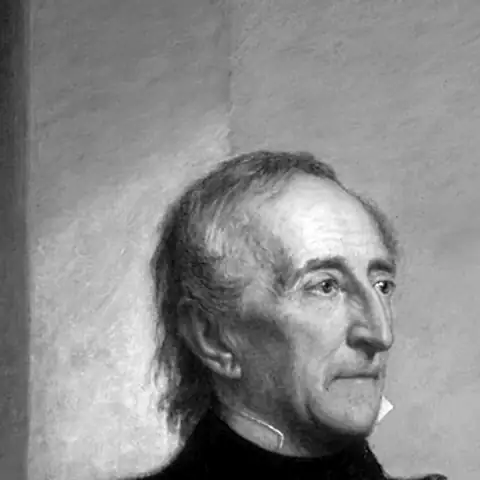
John Tyler
Historical figureUnited States1790-1862

John Tyler

10th President of the United States (1841-1845) · Vice President of the United States

Virginia planter who became the tenth president after Harrison's death, clashed with the Whigs who elected him, vetoed their bank bills, brought Texas into the Union and in the end supported the Confederacy.

Profile on 12 axes7 of 12 documented
ECONOMYSTATESOCIETYWORLDOwnershipMarketsWelfareAuthoritySecurityStructureMoralityReligionTechnologyCultureTradeForeign
Where they stood

John Tyler, axis by axis

  1. PublicPrivate

    Public ownership was not a live issue in his day. The score comes from a planter's defence of private property, which included enslaved people.

  2. PlannedFree

    Fought a national bank throughout his career as a tool for federal control of the economy.

  3. SharedSelf-reliant

    Resisted the Whig plan to share land-sale income for public works. No welfare system existed in his time.

  4. DemocraticStrong leader

    Took on every power of the presidency after Harrison died and vetoed his own party's agenda. He was also against votes for men without property.

  5. 05SecurityNo clear record
    LibertyOrder

    The sources show no position on civil liberties or policing. Left blank.

  6. LocalCentral

    A strict reader of the Constitution who defended states' rights. He left Congress over federal limits on slavery in the territories.

  7. 07MoralityNo clear record
    ProgressiveTraditional

    No stand on family life or social customs is recorded beyond the norms of his time. Left blank.

  8. 08ReligionNo clear record
    SecularReligious

    The sources record no stand on religion in public life. Left blank.

  9. 09TechnologyNo clear record
    EmbraceCaution

    No view on record, in a 19th-century setting.

  10. 10CultureNo clear record
    MulticulturalNational identity

    The sources record no stand on immigration. Left blank.

  11. GlobalProtected

    Disliked steep tariffs and vetoed two Whig tariff bills, then signed a reworked bill in 1842. Mildly open to trade.

  12. CooperationStrength

    Annexed Texas and warned European powers off Hawaii, but also settled the Maine border with Britain and opened trade talks with China.

5 axes have no clear record, so matching leaves them out.

Who was John Tyler?

John Tyler was a Virginia planter who enslaved people. He served as governor and as a senator for Virginia. He was a states' rights Democrat who fell out with Andrew Jackson, then joined the Whigs and became vice president in 1841. When William Henry Harrison died a month into office, Tyler claimed the presidency itself and not just its duties, which set the pattern for later successions. He vetoed the Whig plan for a national bank, and the party threw him out. His government settled the Maine border with Britain, opened trade talks with China and brought the Second Seminole War to a close. In his last days he signed the resolution annexing Texas.

Political views

  • He took the presidential oath when Harrison died. Mail addressed to the 'Acting President' went back unopened. That showed a successor holds the whole office.Source: millercenter.org
  • In 1841 he vetoed two Whig bills for a new national bank. Every cabinet member but Daniel Webster then resigned.Source: millercenter.org
  • Defending the power of Southern planters, he was against a big standing army, against protective tariffs and against votes for men who owned no property.Source: millercenter.org
  • In 1842 he vetoed two bills raising tariffs and then signed one whose wording he accepted, while Whigs began impeachment moves against him.Source: millercenter.org
  • He backed the 1842 Webster-Ashburton Treaty, which fixed the Maine boundary, and dispatched the mission that began formal relations with China.Source: millercenter.org
  • He worked to annex Texas as a slave state. When the Senate rejected a treaty, he got it done in 1845 through a joint resolution of Congress.Source: millercenter.org

Legacy

Tyler's best-known mark is a constitutional precedent. He insisted that he was president in full, so later vice presidents could take over smoothly, and the 25th Amendment finally wrote that rule down. Some historians also praise the foreign policy of his years, though Secretary of State Daniel Webster did much of that work. Most scholars who rank presidents call his term divided and weak. Without a party, he used the veto against the very programme that had put him in office. His Texas drive was bound up with spreading slavery, and he enslaved people until he died. When the 1861 Peace Convention failed to reach a deal, he supported Virginia's secession. Voters chose him for the Confederate House, but he died before it sat.

How close are you to John Tyler?

Take the 12 Axes test and see which historical figure is your political twin, axis by axis.

Take the test

John Tyler: questions

Which party did John Tyler belong to?

He began as a Democrat. As a Whig he won the vice presidency in 1840, but the party threw him out in 1841 over his bank vetoes. He served out his term without a party.

Why was Tyler nicknamed His Accidency?

His critics coined it because he became president only by Harrison's death. Tyler would not be called an acting president and exercised every power of the job.

Was John Tyler a Confederate?

Yes. When the 1861 peace effort failed, he backed Virginia's secession and joined the Provisional Confederate Congress. He was then elected to the Confederate House but died in 1862.

Sources