12axes-testTake the test
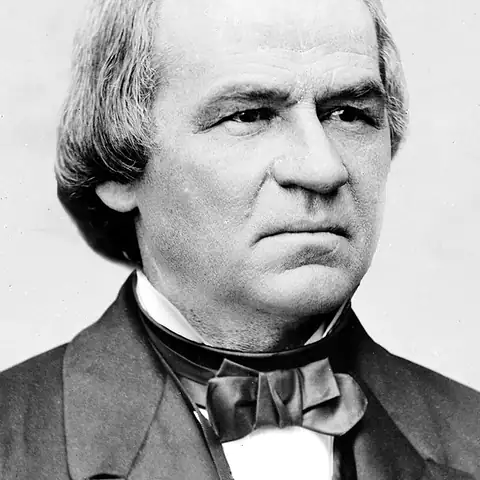
Andrew Johnson
Historical figureUnited States1808-1875

Andrew Johnson

17th President of the United States (1865-1869) · Vice President of the United States

Tennessee Democrat who became president after Lincoln was shot, fought Congress over Reconstruction, resisted rights for freed Black Americans and was impeached in 1868.

Profile on 12 axes6 of 12 documented
ECONOMYSTATESOCIETYWORLDOwnershipMarketsWelfareAuthoritySecurityStructureMoralityReligionTechnologyCultureTradeForeign
Where they stood

Andrew Johnson, axis by axis

  1. PublicPrivate

    A Jacksonian who stood for small farmers and long pushed to give public land to settlers, so he leans toward private ownership.

  2. 02MarketsNo clear record
    PlannedFree

    The sources used here show no clear stance on regulating the economy, so this is left empty.

  3. SharedSelf-reliant

    He vetoed the 1866 Freedmen's Bureau extension and opposed federal help for the formerly enslaved.

  4. DemocraticStrong leader

    He ruled by pardons and vetoes against a Congress with huge majorities, fired his war secretary despite the Tenure of Office Act and was impeached, surviving by one vote.

  5. 05SecurityNo clear record
    LibertyOrder

    He objected to military trials and army rule in the South, but mainly to protect white Southern control, not civil liberties in general. Left empty.

  6. LocalCentral

    He held to a narrow reading of the Constitution. He rejected secession, yet vetoed federal civil rights laws as attacks on states' rights.

  7. 07MoralityNo clear record
    ProgressiveTraditional

    Nothing is recorded on family or social norms beyond the usual views of his day, so this is left empty.

  8. 08ReligionNo clear record
    SecularReligious

    The sources used here record no position, so this is left empty.

  9. 09TechnologyNo clear record
    EmbraceCaution

    No known view, and the question hardly fits his century.

  10. MulticulturalNational identity

    He opposed Black voting and citizenship and played on anti-Black feeling, so he scores strongly toward a narrow national identity.

  11. 11TradeNo clear record
    GlobalProtected

    The sources used here give no clear position on tariffs, so this is left empty.

  12. CooperationStrength

    His government bought Alaska from Russia and pushed France to pull its troops out of Mexico.

6 axes have no clear record, so matching leaves them out.

Who was Andrew Johnson?

Andrew Johnson was born into poverty in 1808 and never went to school. He learned the tailor's trade and set up shop in Greeneville, Tennessee. Entering politics as a Democrat, he served as governor and senator. When Tennessee left the Union in 1861, he stayed in the Senate and stayed loyal. Lincoln later made him a wartime governor of Tennessee and picked him as running mate in 1864. Johnson became president when Lincoln was killed in April 1865. His fight with Republicans in Congress over how to rebuild the South, and over the rights of freed slaves, made him one of the most controversial presidents.

Political views

  • Within months of taking office he let the former Confederate states rejoin the Union on easy terms. He also pardoned thousands of wealthy planters.Source: millercenter.org
  • He would not require Southern states to give Black men the vote before they were readmitted.Source: millercenter.org
  • He vetoed the 1866 bill to extend the Freedmen's Bureau, calling it beyond the powers of the federal government.Source: millercenter.org
  • He vetoed the Civil Rights Act of 1866, which made most people born in the country citizens, saying it trampled on the rights of the states.Source: millercenter.org
  • He fought the Fourteenth Amendment and the Reconstruction Acts, which put the South under army supervision.Source: millercenter.org
  • The House impeached him in 1868 after he fired War Secretary Edwin Stanton. The Senate then fell one vote short of removing him.Source: en.wikipedia.org

Legacy

Most historians place Johnson near the bottom of presidential rankings. They say his Reconstruction plan left freed people open to violence and to the Black Codes passed by Southern legislatures. Critics point to his racist language, his vetoes of civil rights laws and the way his pardons returned the old planter class to power. Early 20th-century writers took a kinder view and cast him as a defender of the Constitution against Radical Republicans, but later scholars mostly dropped that picture. Supporters note his courage in staying loyal to the Union in 1861, his strict reading of the Constitution and the purchase of Alaska arranged by Secretary of State William Seward. His trial still shapes arguments about removing a president.

How close are you to Andrew Johnson?

Take the 12 Axes test and see which historical figure is your political twin, axis by axis.

Take the test

Andrew Johnson: questions

Was Andrew Johnson a Democrat or a Republican?

He was a Democrat. In 1864 he ran as Lincoln's partner on the National Union ticket, a wartime coalition. Once president he fell out with the Republicans and went back to the Democrats.

Why did Andrew Johnson lose the support of Congress?

He wanted to readmit the South quickly and leave the status of freed people to the states. Republicans in Congress wanted federal protection for Black Americans, and they overrode his vetoes.

Was Andrew Johnson removed from office?

No. The House impeached him in 1868 over his firing of Edwin Stanton. The Senate vote to remove him failed by one vote, so he served out his term.

Sources