12axes-testTake the test
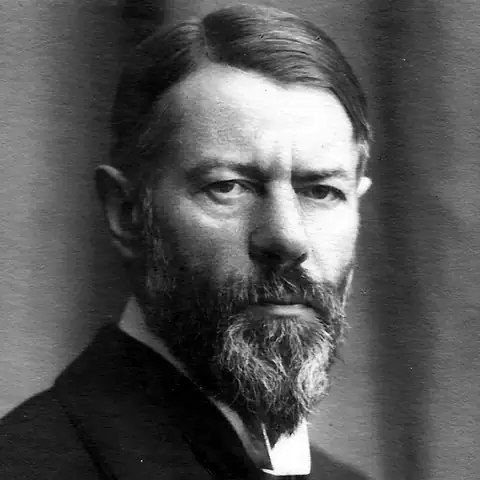
Max Weber
Historical figureGermany1864-1920

Max Weber

Sociologist and political economist · Co-founder of the German Democratic Party

Founder of modern sociology who wrote on bureaucracy, why people obey rulers, and how Protestant belief shaped capitalism. A liberal and a nationalist, he wanted strong elected leaders in a parliamentary state.

Profile on 12 axes5 of 12 documented
ECONOMYSTATESOCIETYWORLDOwnershipMarketsWelfareAuthoritySecurityStructureMoralityReligionTechnologyCultureTradeForeign
Where they stood

Max Weber, axis by axis

  1. PublicPrivate

    A self-described bourgeois liberal, he studied capitalism as a rational system and dreaded creeping bureaucracy. He leans moderately toward private ownership.

  2. PlannedFree
  3. 03WelfareNo clear record
    SharedSelf-reliant
  4. DemocraticStrong leader

    He wanted more democracy and the vote for everyone, but he also favored forceful leaders picked by the public and a strong elected president to hold officials in check. Critics link that to authoritarian tendencies.

  5. 05SecurityNo clear record
    LibertyOrder
  6. 06StructureNo clear record
    LocalCentral
  7. 07MoralityNo clear record
    ProgressiveTraditional
  8. 08ReligionNo clear record
    SecularReligious

    He studied religion very closely but offered no plan for its role in public life, so this axis is left blank, as with other axes that lack a recorded position.

  9. 09TechnologyNo clear record
    EmbraceCaution
  10. MulticulturalNational identity

    In a lecture at Freiburg in 1895 he attacked Polish immigration, and for six years in the 1890s he belonged to the Pan-German League. Scholars debate how far he supported Germanization.

  11. 11TradeNo clear record
    GlobalProtected
  12. CooperationStrength

    He saw politics largely as a contest of national power and first supported the war. But he spoke against taking over Belgium and against all-out submarine warfare.

7 axes have no clear record, so matching leaves them out.

Who was Max Weber?

Max Weber was born in Erfurt, in Prussia, in 1864. His family was wealthy and close to politics. He held professorships at Freiburg and Heidelberg, but a mental collapse in 1903 pulled him out of normal teaching until 1919. His writing, among it The Protestant Ethic and the lecture Politics as a Vocation, laid the ground for modern sociology. At the start of World War I he backed Germany, but he later became a sharp critic of the Kaiser's rule. He helped found the liberal German Democratic Party in 1918, gave advice at Versailles and on the Weimar Constitution, and died of pneumonia in Munich in 1920.

Political views

  • His famous definition says the state is the organization that alone may legitimately use force within its territory.Source: plato.stanford.edu
  • He sorted legitimate rule into three types: the charismatic, the traditional and the legal-rational.Source: plato.stanford.edu
  • He worried that bureaucracy brings efficiency but can trap people in an 'iron cage' where freedom wastes away.Source: plato.stanford.edu
  • He said a responsible politician needs two things: firm convictions and a sense of duty for what actions lead to.Source: en.wikipedia.org
  • In wartime Germany he called for more democracy, votes for all and a stronger parliament, and he backed a powerful president elected by the people.Source: en.wikipedia.org
  • He opposed the 1918 revolution and the Treaty of Versailles, and he denied that Germany alone was guilty of starting the war.Source: plato.stanford.edu

Legacy

Weber ranks among the founders of sociology, and political scientists still use his ideas about bureaucracy, charisma, legitimacy and the state. Liberals admire the way he defended individual freedom against the machinery of administration, and the hard-headed way he described leaders who must compromise. Critics point to his fierce nationalism, his early hostility toward Polish immigrants and his love of national power. Jürgen Habermas and others say his picture of leader democracy, with a strong president, fed authoritarian currents in Weimar Germany. His defenders answer that he always wanted leaders held to account by voters. Many people still read Politics as a Vocation for its guidance on ethics in leadership.

How close are you to Max Weber?

Take the 12 Axes test and see which historical figure is your political twin, axis by axis.

Take the test

Max Weber: questions

Was Max Weber a liberal or a conservative?

He called himself a bourgeois liberal and in 1918 helped start the liberal German Democratic Party. Yet his liberalism sat alongside strong German nationalism and a stress on national power.

What is Weber's definition of the state?

In his 1919 lecture Politics as a Vocation he called the state a human community that successfully claims the sole right to use legitimate force on its territory.

Sources