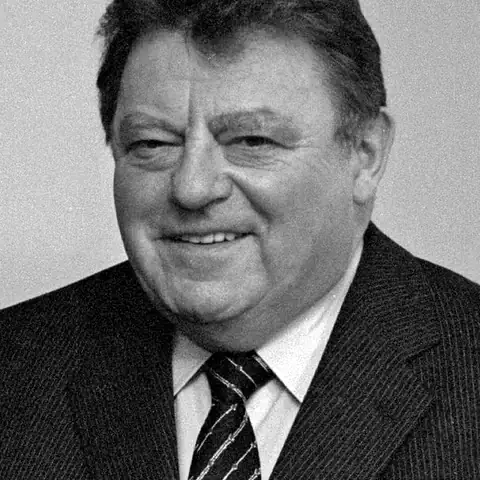
Who was Franz Josef Strauss?
Franz Josef Strauss was born in Munich, the son of a butcher. He served as an officer in the German army in the war and helped set up the Christian Social Union, the CSU, in 1945. He entered the Bundestag in 1949. Chancellor Adenauer made him a minister, first for atomic questions and later for the armed forces. The Spiegel affair cost him the defence job in 1962. From 1961 he chaired the CSU, and later he was finance minister in the Grand Coalition. From 1978 he ran Bavaria until he died in 1988. In 1980 he stood for chancellor and lost to Helmut Schmidt.
Political views
- Drove the growth of the new West German army after becoming defence minister in 1956.Source: hdg.de
- As finance minister from 1966 to 1969 he lowered taxes and teamed up with the Social Democrat Karl Schiller on a policy of steering demand that ended the recession.Source: hdg.de
- Fought hard against Willy Brandt's opening to the East, known as Ostpolitik.Source: hdg.de
- Fought the 1976 election with a simple choice for voters: freedom, or socialism.Source: hdg.de
- Helped East Germany get a credit of one billion marks in 1983, and he sat down with Erich Honecker.Source: hdg.de
- Spoke against the disarmament steps taken under Helmut Kohl in 1987.Source: hdg.de
- Was a driving force behind the creation of Airbus and headed the German company's oversight board.Source: en.wikipedia.org
Legacy
Admirers say Strauss built up the Bundeswehr, made the CSU a party with a mass membership and turned Bavaria from a farming region into a centre of high-tech industry. Tens of thousands came to his funeral. Critics saw a politician who threatened democratic habits. The 1962 Spiegel affair is the main charge. He admitted a role in the raid on the magazine and in the arrests of its owner, Rudolf Augstein, and of an editor, Conrad Ahlers. Five FDP ministers quit in protest, and soon he was out of the cabinet too. Questions were also asked about the Fibag affair. In 1984 he accepted a decoration from South Africa's apartheid state. Willy Brandt called him a strong engine with a weak brake.