12axes-testTake the test
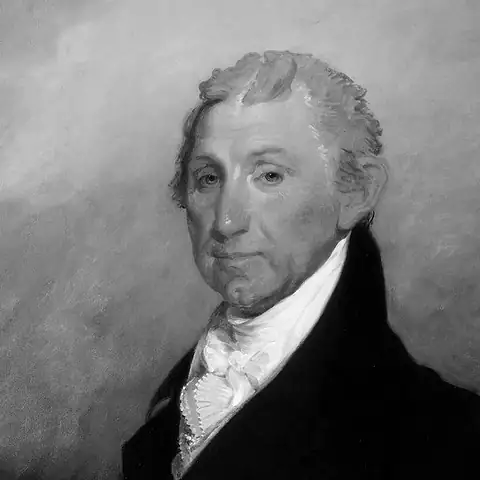
James Monroe
Historical figureUnited States1758-1831

James Monroe

5th President of the United States (1817-1825) · U.S. Secretary of State

The fifth U.S. president and the last of the early Virginians, his term brought calm politics, the Florida purchase, the Missouri deal and a famous warning to Europe.

Profile on 12 axes8 of 12 documented
ECONOMYSTATESOCIETYWORLDOwnershipMarketsWelfareAuthoritySecurityStructureMoralityReligionTechnologyCultureTradeForeign
Where they stood

James Monroe, axis by axis

  1. PublicPrivate
  2. PlannedFree
  3. SharedSelf-reliant

    There was no federal welfare. The score is based on how little Washington did about the 1819 crash, and on the modest local poor relief of the age.

  4. DemocraticStrong leader
  5. LibertyOrder

    He leans toward order chiefly because of how he dealt with Gabriel's plot as governor, which ended in 26 hangings. Few civil liberties fights came up while he was president.

  6. LocalCentral

    He blocked federal road tolls as beyond Congress's authority, then approved road surveys and extensions. That mix keeps the score near the middle.

  7. 07MoralityNo clear record
    ProgressiveTraditional

    Aside from the norms of his day, no record of a stance on family or social customs, so it is left empty.

  8. 08ReligionNo clear record
    SecularReligious

    The sources used here show no stance on religion in public life, so it is left empty.

  9. 09TechnologyNo clear record
    EmbraceCaution

    No recorded view, and the early 19th-century setting gives little to go on.

  10. 10CultureNo clear record
    MulticulturalNational identity

    The sources used here show no stance on immigration or cultural diversity, so it is left empty.

  11. GlobalProtected

    He approved the protective Tariff of 1824, in step with the post-war move toward tariffs and a national bank.

  12. CooperationStrength

    It tilts toward sovereignty because of the unilateral Monroe Doctrine and the armed pressure on Spain before Florida changed hands. His slowness to recognize Latin American republics pulls it back a little.

4 axes have no clear record, so matching leaves them out.

Who was James Monroe?

Monroe was a Revolutionary War soldier, wounded at Trenton. His later career took in the Senate, diplomatic posts in Paris and London, the Virginia governor's chair, and the State and War departments in James Madison's cabinet. A Democratic-Republican, he won the presidency in 1816. By 1820 the Federalists had faded so far that nobody seriously ran against him, and the period earned the label Era of Good Feelings. Yet it was not calm throughout. A financial crash hit in 1819, Congress split over whether Missouri could allow slavery, Spain gave up Florida, and in 1823 Monroe sent a message to Congress that later got his name.

Political views

  • His 1823 message told European powers not to plant new colonies in the Americas, and promised that the U.S. would not take sides in Europe's conflicts.Source: millercenter.org
  • He signed the Missouri Compromise of 1820. It paired a slave state, Missouri, with a free one, Maine, and closed the northern part of the Louisiana Purchase to slavery.Source: millercenter.org
  • In 1818 Andrew Jackson led troops into Seminole territory on his orders. A treaty with Spain the next year then transferred Florida to the U.S.Source: millercenter.org
  • His answer to the Panic of 1819 was mainly to ease the terms for people buying federal land. He expected the economy to mend itself.Source: en.wikipedia.org
  • In 1824 he signed a tariff that raised duties to shelter American manufacturers.Source: millercenter.org
  • He vetoed a 1822 bill for tolls on the Cumberland Road, saying Congress lacked the power, yet later signed bills to survey and extend the road.Source: avalon.law.yale.edu
  • When Gabriel planned a slave rebellion in 1800, Monroe, then Virginia's governor, called out the militia. Twenty-six of the enslaved men seized were put to death by hanging.Source: en.wikipedia.org

Legacy

Fans of Monroe point to the sense of shared purpose that followed the War of 1812, to skilled diplomacy that won Florida and welcomed the new Latin American republics, and to a principle that shaped American foreign policy for a century. Detractors say his administration offered little help after the 1819 crash, and that the Missouri deal pushed the slavery quarrel into the future without solving it. Monroe held enslaved people for life. Historians also note that the Florida campaign hit Seminole and Creek towns that gave shelter to people fleeing slavery. Presidents after him leaned on the Monroe Doctrine to defend interventions that many Latin Americans regarded as imperial.

In their own words

“The American continents, by the free and independent condition which they have assumed and maintain, are henceforth not to be considered as subjects for future colonization by any European powers.”
Seventh Annual Message to Congress (the Monroe Doctrine), 1823

How close are you to James Monroe?

Take the 12 Axes test and see which historical figure is your political twin, axis by axis.

Take the test

James Monroe: questions

What was the Monroe Doctrine?

It was Monroe's 1823 statement that Europe should stop colonizing the Americas, while the U.S. would stay out of Europe's wars. Later presidents cited it to explain actions in Latin America.

What was the Era of Good Feelings?

People used this phrase for Monroe's time in office, when the Federalists vanished and party rivalry cooled. Real conflicts still broke out, among them the 1819 crash and the Missouri crisis.

Did James Monroe own slaves?

Yes. He enslaved people for his whole life, and as president he signed the compromise that let Missouri enter the Union with slavery.

Sources