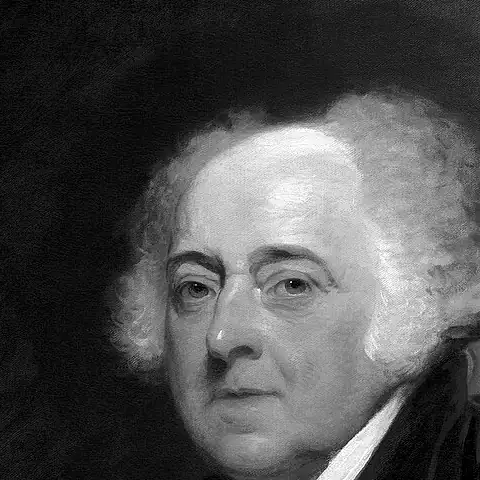
Who was John Adams?
John Adams was one of the loudest voices for independence in the Continental Congress. Later he represented the new country abroad in France, the Netherlands and Britain, and he drafted most of the Massachusetts state constitution in 1780. He served two terms as Washington's vice president, then was president from 1797 to 1801. A Federalist, he distrusted the French Revolution and led the country through the Quasi-War with France. Thomas Jefferson beat him in the 1800 election. Adams, unlike some other presidents of the founding era, never enslaved anyone.
Political views
- Most of the Massachusetts state constitution of 1780 came from his pen, and it remains the oldest written constitution still in force.Source: masshist.org
- He was wary of close ties with France in its revolution, because he feared terror and chaos.Source: millercenter.org
- He put his name to the Alien and Sedition Acts, laws that restricted non-citizens and criminalized some criticism of the government.Source: archives.gov
- He went along with new taxes, including ones on stamps and houses, to pay for defense during the crisis with France.Source: millercenter.org
- In his inaugural speech he promised neutrality in Europe's wars and peace with every nation.Source: avalon.law.yale.edu
- He described the Christian religion as one of the best qualifications for those serving the public.Source: avalon.law.yale.edu
Legacy
Supporters admire his sense of principle. He defended the British soldiers tried after the Boston Massacre, pressed for independence and wrote a state constitution that lasted. He also sent envoys to France to seek peace instead of widening the conflict, though it cost him votes. His ideas on balanced government and separated powers shaped American thinking. Readers still enjoy the letters he exchanged with his wife Abigail and with Jefferson. Critics concentrate on the Alien and Sedition Acts, which were used to prosecute editors of opposition papers. The National Archives says the trials set off a storm of protest and helped bring the Federalists down in 1800. People who knew him called him vain and suspicious, and Jeffersonians suspected him of liking monarchy because he valued a dignified executive.
In their own words
“The existence of such a government as ours for any length of time is a full proof of a general dissemination of knowledge and virtue throughout the whole body of the people.”