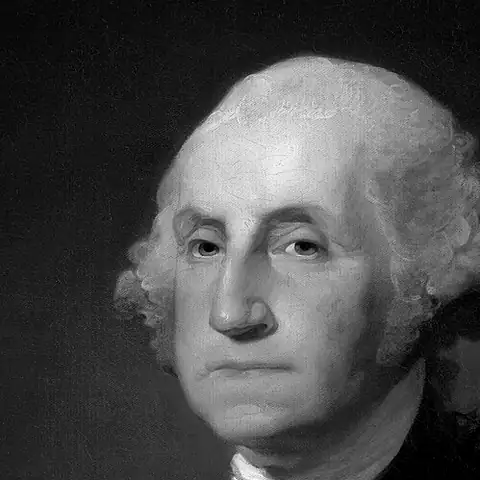
Who was George Washington?
George Washington commanded the Continental Army in the American Revolutionary War. In 1787 he chaired the Constitutional Convention, and from 1789 to 1797 he served as the nation's first president. Many customs of the office began with him, including the cabinet and the habit of serving only two terms. He sided with those who thought the Articles of Confederation left the center too weak. In office he usually supported the financial plans of his Treasury chief, Alexander Hamilton. Washington was also a major Virginia landowner, and hundreds of people were enslaved on his lands.
Political views
- Wanted a stronger national government and chaired the convention that wrote the Constitution.Source: millercenter.org
- Agreed with Hamilton on paying off the national debt, absorbing state debts and founding a national bank.Source: millercenter.org
- Announced in 1793 that America would stay neutral as France and Britain fought.Source: avalon.law.yale.edu
- In his Farewell Address he warned against lasting foreign alliances and against party spirit.Source: avalon.law.yale.edu
- Called religion and morality essential props of political prosperity.Source: avalon.law.yale.edu
- Left office on his own after two terms, setting an example of peaceful handover.Source: millercenter.org
Legacy
To many Americans Washington is the central figure of the founding years. Admirers praise his refusal to take more power than he needed, his decision to retire and his role in keeping the new union together. Historians often place him near the top of presidential rankings. Critics, and many historians, stress that he held hundreds of people in bondage, and that slavery paid for the life that made his public career possible. The Miller Center calls it the hardest part of his story to face. His attitude toward slavery shifted over time, and his will freed the people he held once his wife had died. In the 1790s Jeffersonian opponents said his government favored merchants and creditors.
In their own words
“It is our true policy to steer clear of permanent alliances with any portion of the foreign world.”
“Of all the dispositions and habits which lead to political prosperity, religion and morality are indispensable supports.”