12axes-testTake the test
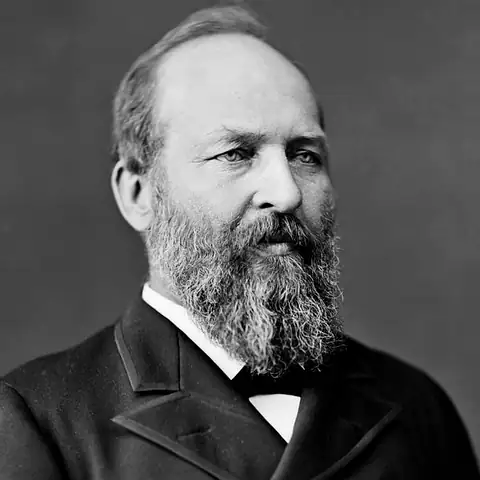
James A. Garfield
Historical figureUnited States1831-1881

James A. Garfield

20th President of the United States (1881) · U.S. Representative from Ohio

Ohio Republican, Union general and 20th president, whose short term was spent in a fight with party boss Roscoe Conkling over jobs and who was shot four months after taking office.

Profile on 12 axes5 of 12 documented
ECONOMYSTATESOCIETYWORLDOwnershipMarketsWelfareAuthoritySecurityStructureMoralityReligionTechnologyCultureTradeForeign
Where they stood

James A. Garfield, axis by axis

  1. 01OwnershipNo clear record
    PublicPrivate

    The sources here record no position, so this axis is left empty.

  2. PlannedFree

    He backed the gold standard for his whole career and opposed expanding paper currency.

  3. 03WelfareNo clear record
    SharedSelf-reliant

    He called for universal education but died before laying out any spending plans, so this axis is left empty.

  4. DemocraticStrong leader

    He wanted civil service jobs set by law, yet he also fought Conkling to prove the president had the power to appoint.

  5. 05SecurityNo clear record
    LibertyOrder

    No position as president is documented, so this axis is left empty.

  6. LocalCentral

    His inaugural address stressed that the Union was permanent and that the nation shared responsibility for the rights of freed people.

  7. ProgressiveTraditional

    In his inaugural address he condemned Mormon polygamy and asked Congress to put an end to it.

  8. 08ReligionNo clear record
    SecularReligious

    He condemned polygamy but promised respect for conscience. With no wider plan for religion in law, this axis is left empty.

  9. 09TechnologyNo clear record
    EmbraceCaution

    No view is recorded, and the 19th-century setting offers no basis for one.

  10. MulticulturalNational identity

    He called the rise of formerly enslaved people to full citizenship the biggest political change since the Constitution, so he scores toward an inclusive idea of citizenship.

  11. 11TradeNo clear record
    GlobalProtected

    The sources used here show no firm position on the tariff, so this axis is left empty.

  12. 12Foreign policyNo clear record
    CooperationStrength

    He died before he could set a foreign policy, so this axis is left empty.

7 axes have no clear record, so matching leaves them out.

Who was James A. Garfield?

James Garfield was born in 1831 in a log cabin in Ohio. He paid his own way through college, taught, preached and ran a school, and then fought as a general for the Union in the Civil War. He later spent 17 years in the House of Representatives, where he was known for his command of money and finance. In 1880 he went to the Republican convention to back someone else. Instead the delegates picked him as a compromise on the 36th ballot, and he narrowly won the election. As president he battled Senator Roscoe Conkling of New York over who controlled federal jobs. On 2 July 1881 an angry office seeker, Charles Guiteau, shot him. Garfield died on 19 September.

Political views

  • Supported the gold standard all through his career and opposed putting more paper money into circulation.Source: en.wikipedia.org
  • Said in his inaugural address that the Union was permanent under the Constitution and that freed people had earned full rights as citizens.Source: millercenter.org
  • Held that civil service jobs would never be run properly until the law set the rules.Source: millercenter.org
  • Gave the top customs job in New York to an enemy of Conkling, breaking the senator's claim to control it under senatorial courtesy.Source: millercenter.org
  • Spoke against Mormon polygamy and asked Congress to ban it, while saying conscience should be respected.Source: millercenter.org

Legacy

Garfield held office for too short a time to leave a real policy record, so historians tend to leave him unranked or in the middle. His murder by a rejected office seeker gave new energy to civil service reform, and it helped pass the Pendleton Act of 1883 under Chester Arthur. Admirers stress his rise from poverty, his wide learning and his public support for education and citizenship for Black Americans, at a time when many Republicans were giving up on Reconstruction. Critics bring up the Credit Mobilier railroad scandal, though he denied any wrongdoing. Historians also note that poor medical care, with unclean hands and instruments, probably did more to kill him than the bullet.

In their own words

“The civil service can never be placed on a satisfactory basis until it is regulated by law.”
Inaugural Address, 1881

How close are you to James A. Garfield?

Take the 12 Axes test and see which historical figure is your political twin, axis by axis.

Take the test

James A. Garfield: questions

Which party did James Garfield belong to?

He was a Republican. He represented Ohio in the House for 17 years before winning the presidency in 1880.

How did James Garfield die?

Charles Guiteau shot him at a Washington railway station on 2 July 1881. He lived for about 11 weeks more and died on 19 September. Many historians think the poor medical care he received made his condition worse.

Why is Garfield important for civil service reform?

His killer was a man who wanted a government job and did not get one. The public outrage helped pass the Pendleton Act of 1883, which began hiring federal workers on merit.

Sources