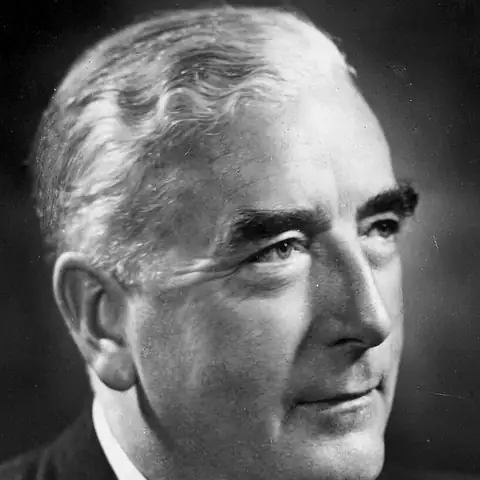
Who was Robert Menzies?
Robert Gordon Menzies came from the small town of Jeparit in Victoria, where he was born in 1894. He first became a leading barrister in constitutional law. He argued the Engineers case in 1920, a landmark that widened federal power. After entering politics he led the government for the United Australia Party from 1939 until he stepped down in 1941. He then built a new party, the Liberals, in 1944-1945, and it won office in 1949. That began a stretch of more than sixteen years in power, ended by his retirement in 1966, the longest run any Australian prime minister has had. He died in 1978.
Political views
- He described the middle class as the country's backbone and put homes, thrift and personal effort at the centre of its values.Source: menziesrc.org
- In the 1949 campaign he fought Labor's bank nationalisation plan and condemned the 'Socialist State', as he put it.Source: moadoph.gov.au
- He said you cannot put the means of production under common control without also controlling the people who work in it.Source: moadoph.gov.au
- In 1949 he vowed to make the Communist Party illegal and dissolve it.Source: moadoph.gov.au
- At the 1951 referendum he asked voters for powers to act against communists. They said no.Source: aec.gov.au
- He defended the Empire, the Crown and preferential trade within the Empire.Source: moadoph.gov.au
- He started the Colombo Plan, which brought tens of thousands of Asian students to Australian universities.Source: en.wikipedia.org
- Australian troops went to Korea, to the Malayan Emergency and to Vietnam on his orders.Source: en.wikipedia.org
Legacy
His admirers point to a long postwar boom, greater funding for universities, the ANZUS alliance, the Colombo Plan, aid for church schools and a big immigration program. He is the Liberals' founding father. Critics say his governments grew complacent and put off economic reform, that his bid to ban the Communist Party endangered civil liberties, and that he held on to the White Australia policy. The 1965 decision to commit combat troops to Vietnam is still debated, and so is his devotion to Britain and the monarchy. Later Liberal leaders are often judged against him.
In their own words
“You cannot socialise the means of production without socialising men and women.”