12axes-testTake the test
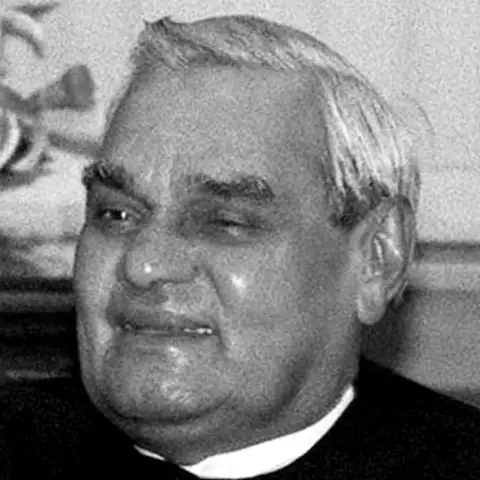
Atal Bihari Vajpayee
Historical figureIndia1924-2018

Atal Bihari Vajpayee

10th Prime Minister of India (1996, 1998-2004) · Co-founder of the Bharatiya Janata Party

Poet, journalist and BJP founder who was prime minister from 1998 to 2004. His time in power brought nuclear tests, a peace bid to Pakistan and a smaller state role in business.

Profile on 12 axes11 of 12 documented
ECONOMYSTATESOCIETYWORLDOwnershipMarketsWelfareAuthoritySecurityStructureMoralityReligionTechnologyCultureTradeForeign
Where they stood

Atal Bihari Vajpayee, axis by axis

  1. PublicPrivate
  2. PlannedFree
  3. SharedSelf-reliant

    People remember highways and less state involvement in business, not redistribution. Placed at the midpoint.

  4. DemocraticStrong leader

    Served in parliament for more than forty years, was imprisoned under the Emergency and governed with a broad alliance. Leans toward democratic checks.

  5. LibertyOrder
  6. LocalCentral
  7. ProgressiveTraditional
  8. SecularReligious
  9. EmbraceCaution
  10. MulticulturalNational identity

    His roots were in the RSS and the BJP, which stand for Hindu nationalism. Many saw him as a moderate who restrained the hardliners, yet his 2002 comments on Muslims drew criticism. Leans toward national identity.

  11. 11TradeNo clear record
    GlobalProtected

    No clear trade stance apart from the broader reforms of those years, so no score.

  12. CooperationStrength

    He ordered the 1998 nuclear tests and went to war at Kargil. He also rode a bus to Pakistan to seek peace. Leans toward strength.

One axis has no clear record, so matching leaves it out.

Who was Atal Bihari Vajpayee?

Vajpayee came from Gwalior, where he was born in 1924 to a schoolteacher. He took part in the Quit India movement as a student and then worked as a journalist. In 1951 he joined the Bharatiya Jana Sangh, and six years later he won a seat in parliament. The Emergency put him in jail. When Janata took power in 1977 he became India's foreign minister, and in 1980 he helped start the BJP. He led a short-lived government in 1996, then ran the National Democratic Alliance from 1998 until 2004. His Hindi poetry was widely admired. He died in 2018.

Political views

  • Rose through the Hindu nationalist RSS, but in parliament he gained a name for steering a moderate path.Source: bbc.com
  • Earned praise in office for cutting the state's part in running firms and for a big program of national highways.Source: bbc.com
  • Only weeks into his 1998 term he approved five underground nuclear blasts, and he kept going despite sanctions from Western states.Source: latimes.com
  • In 1999 he crossed into Pakistan by bus. At the summit that followed, both governments promised to work on their disputes, Kashmir included.Source: latimes.com
  • Told a rally in 1992 that the land at Ayodhya must be flattened. Mobs razed the Babri mosque the next day, and he later called that act a mistake.Source: latimes.com
  • Faced criticism over a party speech in Goa in 2002, after the Gujarat riots, in which he claimed Muslims did not want to live in peace beside others.Source: independent.co.uk
  • His government's biography calls him a champion of women and of equality, and says he saw India as a civilisation 5,000 years old.Source: pmindia.gov.in

Legacy

To his fans Vajpayee was an orator and poet who brought the BJP into government, held an unlikely coalition together and tried to make peace with Pakistan. Some said he was the right man in the wrong party. They give his years in office credit for economic opening, better roads and the win at Kargil in 1999. Opponents say the 1998 tests set off a nuclear arms race in South Asia, and that he made Hindu nationalism look respectable. They also blame him for not removing Narendra Modi from the top job in Gujarat after the 2002 riots, when over 1,000 people died, mostly Muslims.

How close are you to Atal Bihari Vajpayee?

Take the 12 Axes test and see which historical figure is your political twin, axis by axis.

Take the test

Atal Bihari Vajpayee: questions

Was Atal Bihari Vajpayee left or right?

He was on the right. He led the BJP, backed a smaller state role in business and grew up in the Hindu nationalist movement. But many saw him as a moderate who worked with allies from across the spectrum.

Which party did Vajpayee found?

He was a co-founder of the Bharatiya Janata Party in 1980. Earlier he had belonged to the Bharatiya Jana Sangh and then the Janata Party. As prime minister he headed the National Democratic Alliance.

Why did India test nuclear weapons in 1998?

Vajpayee approved five underground tests soon after taking office and held firm when Western states imposed sanctions. Supporters saw a show of national strength. Critics said it sped up an arms race with Pakistan.

Sources