12axes-testTake the test
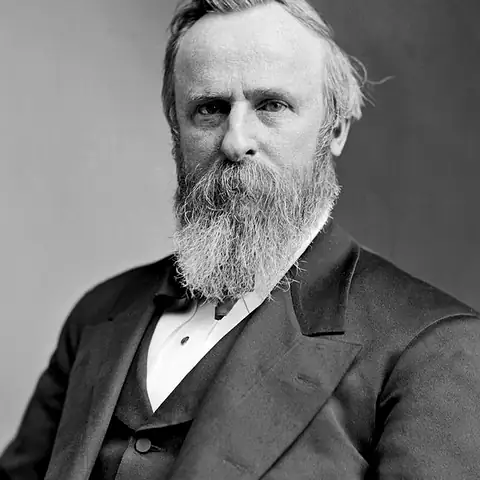
Rutherford B. Hayes
Historical figureUnited States1822-1893

Rutherford B. Hayes

19th President of the United States (1877-1881) · Governor of Ohio

Nineteenth president who won the disputed 1876 election, ended federal military backing for Southern Republican governments, used troops in the 1877 railroad strike and pushed civil service reform.

Profile on 12 axes9 of 12 documented
ECONOMYSTATESOCIETYWORLDOwnershipMarketsWelfareAuthoritySecurityStructureMoralityReligionTechnologyCultureTradeForeign
Where they stood

Rutherford B. Hayes, axis by axis

  1. PublicPrivate

    Public ownership was not a live issue then. The score comes from his backing of a private economy and sound money.

  2. PlannedFree

    Fought inflationary greenbacks and free silver coinage and preferred a currency backed by gold.

  3. SharedSelf-reliant

    Would not seek railroad subsidies but asked for federal help with schooling, arguing that a universal vote needs universal education. Near the middle.

  4. DemocraticStrong leader

    Promised to serve one term and pushed civil service reform against the patronage habits of his own party.

  5. LibertyOrder

    Sent federal troops into the Great Strike of 1877 when state officials asked, starting a habit of using the Army in labour disputes.

  6. LocalCentral

    Pulled out the last federal troops that backed Southern Republican governments, though later vetoes kept some federal oversight of elections. Slightly local.

  7. ProgressiveTraditional

    Based on the temperance household kept by Hayes and Lucy Hayes at the White House, and the social customs of their time.

  8. 08ReligionNo clear record
    SecularReligious

    The sources show no stand on religion in public life. Left blank.

  9. 09TechnologyNo clear record
    EmbraceCaution

    No view on record, in a 19th-century setting.

  10. MulticulturalNational identity

    Blocked a bill restricting Chinese immigration as a breach of the Burlingame Treaty, then won a new treaty giving the United States power to control and pause Chinese labour immigration.

  11. 11TradeNo clear record
    GlobalProtected

    The sources show no stand on the tariff. Left blank.

  12. CooperationStrength

    Insisted that a Central American canal had to be American-controlled, and let troops follow bandits into Mexico.

3 axes have no clear record, so matching leaves them out.

Who was Rutherford B. Hayes?

Before politics, Rutherford B. Hayes was an Ohio lawyer and a Union officer who took several wounds in battle. He later served in Congress and won three terms as Ohio's governor. The 1876 race against Samuel Tilden ended in dispute, because returns from three Southern states were contested. A special commission handed those states to Hayes. It was widely understood that, in return, Washington would stop propping up the remaining Republican governments in the South. Once in office he withdrew the troops. A nationwide railroad strike hit in 1877, and he defended a gold-backed dollar. He challenged his party's patronage machine, kept his vow to serve one term and later worked for schools and prison reform.

Political views

  • He pulled federal troops out of Louisiana and South Carolina, where they had propped up Republican governments, after Democratic leaders promised to respect the civil and voting rights of Black citizens.Source: millercenter.org
  • He pressed hard for civil service reform, and Republican bosses who lived on patronage resented it.Source: millercenter.org
  • He fought greenbacks and free silver coinage and stood for a currency backed by gold.Source: millercenter.org
  • Federal troops went out on his orders to keep the peace during the Great Strike of 1877, the first time the Army was used inside states in a labour dispute.Source: millercenter.org
  • He asked for federal help for schools, saying that the right to vote should rest on a universal education.Source: millercenter.org
  • A bill capping Chinese passengers per ship got his veto, since it broke a treaty. He then agreed a new treaty under which the United States could control and halt Chinese labour immigration.Source: millercenter.org
  • In 1880 he declared it American policy that a canal across the isthmus must be controlled by the United States.Source: millercenter.org

Legacy

Many historians say Hayes restored honesty to the White House after the Grant-era scandals and took early steps toward hiring by merit. His critics point to the troop withdrawal, part of the Compromise of 1877, which closed the Reconstruction era. They argue that it left Black Southerners facing lost votes and segregation, whatever promises he had won. Labour historians add that sending the Army against strikers in 1877 set a pattern of federal help for employers. At the time, opponents questioned whether he had won fairly and nicknamed him 'His Fraudulency'.

In their own words

“The policy of this country is a canal under American control.”
Special Message to Congress, 1880

How close are you to Rutherford B. Hayes?

Take the 12 Axes test and see which historical figure is your political twin, axis by axis.

Take the test

Rutherford B. Hayes: questions

Which party did Rutherford B. Hayes belong to?

He was a Republican. An electoral commission settled the disputed 1876 election in his favour, and he served a single term.

What was the Compromise of 1877?

It is the label for the unwritten deal that settled the contested 1876 vote. Hayes became president, and in turn the last federal troops stopped propping up Republican rule in the South. Reconstruction ended.

Why was Hayes called His Fraudulency?

Opponents thought the 1876 election had been taken from Samuel Tilden, who won more popular votes. They used the nickname to say that Hayes had not won fairly.

Sources