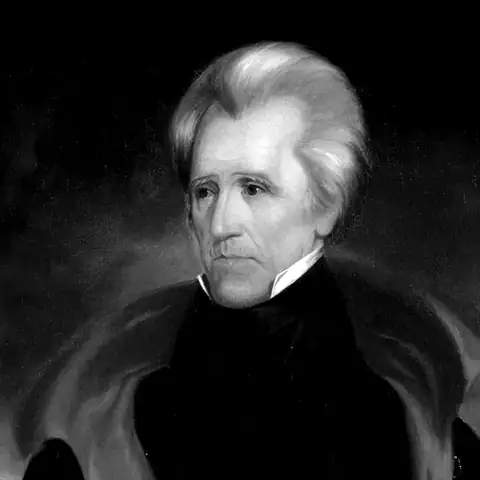
Who was Andrew Jackson?
Andrew Jackson lived from 1767 to 1845. He was a frontier lawyer, planter and slaveholder from Tennessee. His 1815 win against British forces at New Orleans made him a hero, and his earlier wars against the Creek and Seminole added to his fame. He lost the contested election of 1824 but won the White House in 1828 and again in 1832. His supporters formed what became the Democratic Party, which cast him as a voice for ordinary Americans against elites. As president he fought the national bank, resisted South Carolina over the tariff and pushed Native peoples west of the Mississippi.
Political views
- In 1832 he vetoed the renewal of the Second Bank of the United States. He argued it was a monopoly that helped the wealthy and powerful.Source: avalon.law.yale.edu
- He pushed hard for the 1830 Indian Removal Act. His government then used the law to sign treaties, often under heavy pressure, that sent Native nations west.Source: history.state.gov
- In 1832 he declared that no state could void a federal law or leave the Union. At the same time he asked Congress to cut the tariff.Source: avalon.law.yale.edu
- In 1830 he vetoed the Maysville Road bill. He did not think the federal government should pay for local transport projects.Source: millercenter.org
- He believed in rotating office holders and replaced many federal officials with his own backers. Critics named this the spoils system.Source: millercenter.org
- In 1835 he asked Congress to stop abolitionist mail from reaching the South.Source: millercenter.org
Legacy
Admirers say Jackson opened politics to far more white men, took on concentrated financial power and held the Union together when South Carolina threatened to nullify federal law. Critics say he stretched presidential power, handed out government jobs as rewards and helped cause the financial turmoil of the 1830s by destroying the bank. The gravest charge concerns Native Americans. His government pushed roughly 50,000 people west through pressured treaties. It brushed aside a Supreme Court ruling that backed the Cherokee. The forced march of 1838-1839 came soon after, and historians think 3,000 to 4,000 Cherokee people died on it. Jackson also owned enslaved people for most of his life.
In their own words
“It is to be regretted that the rich and powerful too often bend the acts of government to their selfish purposes.”