12axes-testTake the test
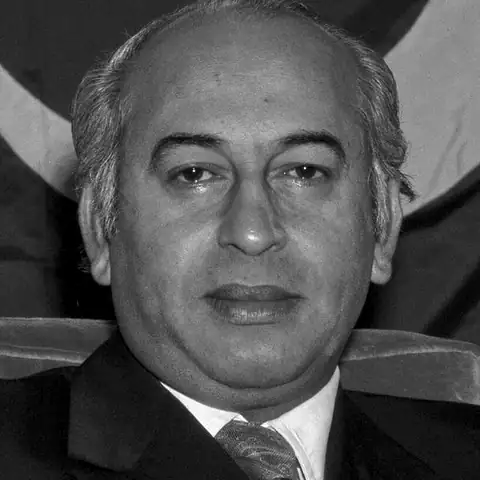
Zulfikar Ali Bhutto
Historical figurePakistan1928-1979

Zulfikar Ali Bhutto

Prime Minister of Pakistan (1973-1977) · President of Pakistan (1971-1973)

Founder of the Pakistan People's Party who nationalized industry, gave Pakistan its 1973 constitution and began its nuclear program, then was overthrown by Zia and hanged in 1979.

Profile on 12 axes8 of 12 documented
ECONOMYSTATESOCIETYWORLDOwnershipMarketsWelfareAuthoritySecurityStructureMoralityReligionTechnologyCultureTradeForeign
Where they stood

Zulfikar Ali Bhutto, axis by axis

  1. PublicPrivate

    His government nationalized key industries, banks, insurance and educational institutions. Critics call the plan poorly executed and his Islamic socialism more rhetoric than practice.

  2. PlannedFree
  3. SharedSelf-reliant
  4. DemocraticStrong leader

    He rebuilt parliamentary government with the 1973 constitution, yet critics describe press censorship, jailed opponents, a standing emergency and use of a federal security force against rivals.

  5. LibertyOrder
  6. LocalCentral

    The 1973 constitution balanced provincial autonomy with federal unity, but critics say he encroached on provincial autonomy in practice.

  7. 07MoralityNo clear record
    ProgressiveTraditional
  8. SecularReligious

    Pakistan became an Islamic republic under his constitution, and a 1974 constitutional amendment passed under him declared Ahmadis non-Muslim, under orthodox pressure. Mild lean toward religion in public life.

  9. 09TechnologyNo clear record
    EmbraceCaution
  10. 10CultureNo clear record
    MulticulturalNational identity
  11. 11TradeNo clear record
    GlobalProtected
  12. CooperationStrength

    He started Pakistan's nuclear program in answer to India's, followed a nonaligned course and turned toward China and Muslim states. Also hosted the 1974 Lahore Islamic summit.

4 axes have no clear record, so matching leaves them out.

Who was Zulfikar Ali Bhutto?

Zulfikar Ali Bhutto was born in Larkana, Sindh, into a landowning family and studied in the United States and at Oxford. He served as foreign minister under Ayub Khan until 1966, then founded the Pakistan People's Party in 1967 on a platform of fairer wealth distribution. After the 1971 war and the loss of East Pakistan, he took over from Yahya Khan as president. A new constitution took effect in 1973, and he became prime minister. General Zia ul-Haq overthrew him in July 1977. A court convicted him of conspiracy to murder, and he was hanged on 4 April 1979.

Political views

  • Founded the Pakistan People's Party in opposition to Ayub Khan on a democratic socialist platform, with the slogan of food, clothing and shelter.Source: dawn.com
  • Announced nationalization of major industries on 2 January 1972, with later phases covering banks, insurance firms and rice-husking units.Source: ebsco.com
  • Introduced land reforms that limited the size of holdings and gave more than one million acres to landless farmers.Source: ebsco.com
  • Presided over the 1973 constitution, adopted unanimously, which made Pakistan an Islamic republic and balanced provincial autonomy with federal unity.Source: dawn.com
  • Funded a secret nuclear weapons program, kept Pakistan independent of both superpowers and hosted the second OIC summit at Lahore in 1974.Source: encyclopedia.com
  • Faced charges of encroaching on provincial autonomy, press censorship and jailing political opponents under a continuing emergency.Source: dawn.com
  • Oversaw the 1974 constitutional amendment that declared Ahmadis non-Muslim, bowing to orthodox pressure.Source: ebsco.com

Legacy

Admirers remember Bhutto as the leader who gave ordinary Pakistanis a political voice, wrote a lasting constitution and restored national confidence after the 1971 defeat. Critics point to nationalizations that slowed growth and left most units losing money, a refusal to accept the 1970 mandate of the Awami League, press censorship and jailed opponents. Doubts about the 1977 election led to unrest and then the army coup. His trial and hanging in 1979 are still disputed, and many Pakistanis consider the verdict unfair. He remains the only prime minister of Pakistan to be executed.

How close are you to Zulfikar Ali Bhutto?

Take the 12 Axes test and see which historical figure is your political twin, axis by axis.

Take the test

Zulfikar Ali Bhutto: questions

Was Zulfikar Ali Bhutto a socialist?

He called his program Islamic socialism and nationalized industries, banks and schools. Critics say the policy was more rhetoric than substance, and he compromised with landed elites.

Why was Zulfikar Ali Bhutto hanged?

A court convicted him of conspiracy to murder the father of a political opponent, and he was hanged on 4 April 1979. Whether the trial was fair is still disputed in Pakistan.

What did Bhutto do for Pakistan's nuclear program?

He started the program in response to India's nuclear work and funded it in secret. It brought him into conflict with the United States.

Sources