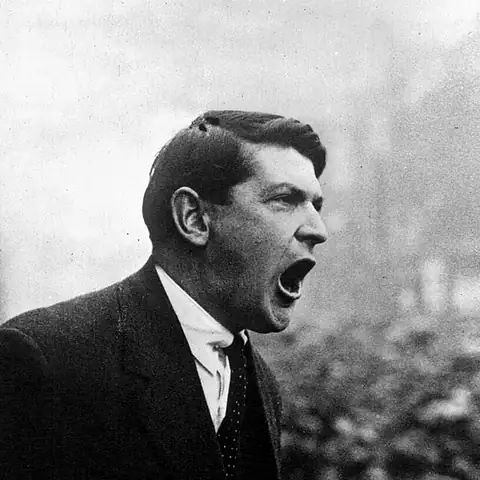
Who was Michael Collins?
Michael Collins was born in County Cork in 1890. He joined the Irish Republican Brotherhood in 1909, fought in the 1916 Easter Rising and was interned in Wales. As director of intelligence for the Irish Volunteers he built a spy network and led a unit known as the Squad. He was Minister for Finance in the First Dáil. In 1921 he was among the delegates who negotiated and signed the Anglo-Irish Treaty. He then chaired the Provisional Government and commanded the Free State army in the Civil War. Anti-treaty fighters ambushed and killed him at Béal na mBláth, County Cork, on 22 August 1922.
Political views
- Joined the Irish Republican Brotherhood in 1909, took part in the 1916 Easter Rising and was interned in Wales until December 1916.Source: encyclopedia.com
- As director of intelligence he built a spy network and led the Squad, a unit that killed British agents.Source: encyclopedia.com
- Served as Minister for Finance in the republican government, raising and distributing money for the independence cause.Source: encyclopedia.com
- Signed the Anglo-Irish Treaty in 1921, which created the Irish Free State as a dominion and left Northern Ireland separate. He called it a stepping stone to full independence.Source: encyclopedia.com
- Told the Dáil that the Treaty gave Ireland the freedom to achieve freedom, not final freedom. Supporters of the Treaty won the ratification vote by seven votes in January 1922.Source: rte.ie
- Reportedly said he had signed his own death warrant when he signed the Treaty.Source: irishhistorycompressed.com
- Supported the revival of the Irish language through the Gaelic League, and accepted partition in the Treaty while hoping for eventual unity.Source: encyclopedia.com
- Chaired the Provisional Government and commanded Free State forces in the Civil War, including the attack on the Four Courts.Source: encyclopedia.com
Legacy
Collins is often credited with turning a rebellion into a workable independence settlement, through intelligence work and a readiness to compromise. Admirers see a pragmatic builder who put the state first. Republicans who rejected the Treaty saw a betrayal because of the oath to the Crown and the partition of the island. Critics also point to the Squad's killings during the War of Independence, and to the Civil War that pitted him against former comrades. His death at 31 led to much idolization and to speculation about the Ireland he might have shaped. Historians still disagree about his legacy.