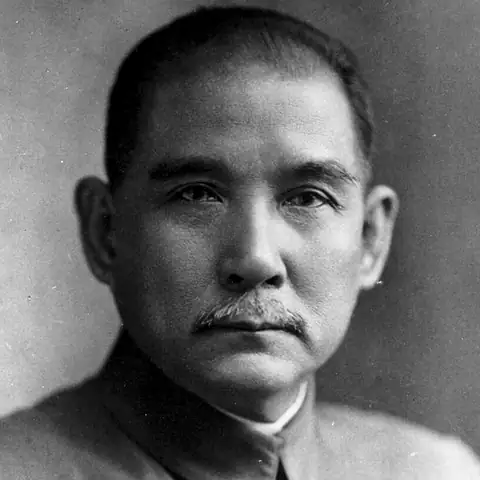
Who was Sun Yat-sen?
Sun came from Guangdong, where he was born in 1866. He attended school in Honolulu and qualified as a physician in Hong Kong. He then gave himself to overthrowing the Qing and, in 1905, brought several revolutionary groups together as the Tongmenghui. After the 1911 uprising, delegates from the provinces named him provisional president of the new republic. He quickly gave the post up to Yuan Shikai. In later years he founded the Kuomintang, ran rival governments from Guangzhou and sought help from Soviet Russia and Chinese communists. Sun died in Beijing in 1925.
Political views
- Treated three ideas as the slogans of the Chinese revolution: nationalism, popular sovereignty and the people's livelihood.Source: revolution.chnm.org
- Compared China to a sheet of loose sand, saying people enjoyed too much personal freedom and had to merge into one solid body to stand up to foreign imperialism.Source: revolution.chnm.org
- Set out stages for reform: first military government, then a period of party tutelage, then full constitutional democracy.Source: en.wikipedia.org
- Drew up a constitution with five branches of government and wanted initiative, referendum and recall used alongside elections.Source: en.wikipedia.org
- Took ideas from Henry George for a land tax based on the owner's own valuation, giving the state a right to purchase land at that stated price.Source: en.wikipedia.org
- Wanted a state-led push for modern industry, with public firms in communications, mining and manufacturing and curbs on private capital.Source: en.wikipedia.org
- U.S. State Department historians describe him as a nationalist with socialist leanings who sought to swap Qing rule for a republic.Source: history.state.gov
Legacy
Sun is respected in both Taipei and Beijing. Taiwan's government names him Father of the Nation, and the mainland describes him as a precursor to its own revolution. Fans see the man who founded Chinese republicanism and modern nationalism, and his Three Principles left a mark on Taiwanese land reform and constitutional design. Skeptics note that his revolution did not make China one country, since warlords carved it up. They add that his doctrine of party tutelage gave the Kuomintang a reason to rule alone, and that in his early years he targeted the Manchus as a race.
In their own words
“The watchword of the French Revolution was "Liberty"; the watchword of the American Revolution was "Independence"; the watchword of our Revolution is the "Three Principles of the People."”