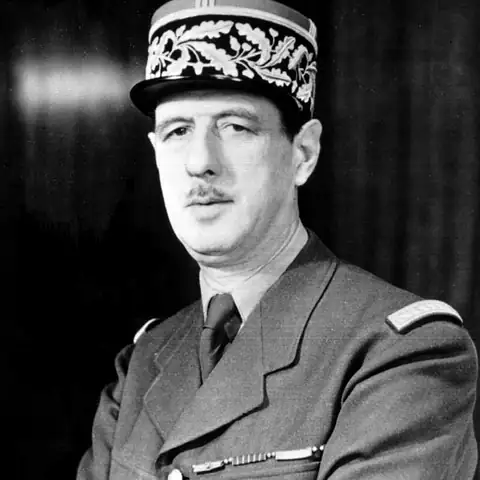
Who was Charles de Gaulle?
Charles de Gaulle was a career army officer. When France signed an armistice with Germany in 1940, he rejected it and urged his countrymen on 18 June to keep fighting. Britain's Churchill accepted him as the leader of the Free French nine days later. He later joined the exiled forces to the Resistance inside France. After heading the Provisional Government from 1944 to 1946, he left politics. The Algerian crisis brought him back in 1958. He wrote a new constitution, which voters approved, and became the first president of the Fifth Republic. He stepped down in April 1969 after losing a referendum.
Political views
- Wanted a strong executive. He set out the idea in 1946, and the 1958 constitution put it into practice.Source: elysee.fr
- In 1962 a referendum approved his plan to have the president chosen by direct popular vote.Source: elysee.fr
- Accepted that Algeria could decide its own future, and the 1962 Evian Agreements opened the way to independence.Source: elysee.fr
- Made national independence the core of French policy. France left NATO's integrated command and built its own nuclear force.Source: en.wikipedia.org
- Blocked Britain from joining the European Economic Community, using his veto twice.Source: en.wikipedia.org
- Preferred a Europe of cooperating sovereign states to a supranational one. In wartime London he had invited Robert Schuman into his team.Source: elysee.fr
- During the May 1968 protests he dissolved the National Assembly, and the election that followed gave him a strong majority.Source: european-union.europa.eu
Legacy
To admirers, de Gaulle stands for French resistance, a steady republic and independence from outside control. Gaullism still shapes French politics. Critics said the Fifth Republic gave the president too much power, and Mitterrand called it a permanent coup. May 1968 and the defeat in the 1969 referendum showed where his authority ended. His Algeria policy upset both settlers and supporters of independence. In 1967 he shouted "Long Live Free Quebec!" on a visit to Canada, which caused a diplomatic row.
In their own words
“Paris! Paris outraged! Paris broken! Paris martyred! But Paris liberated!”