12axes-testTake the test
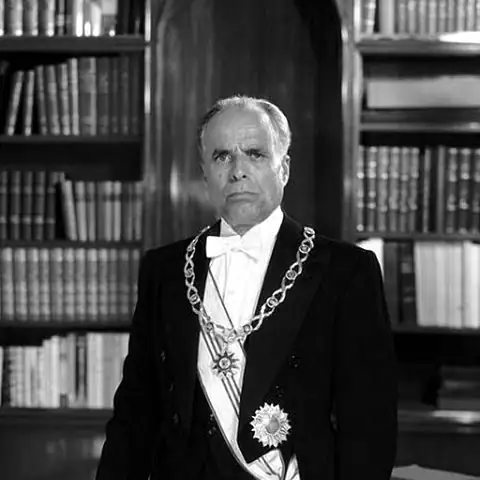
Habib Bourguiba
Historical figureTN1903-2000

Habib Bourguiba

First President of Tunisia (1957-1987) · Founder of the Neo-Destour party

Tunisia's founding president. He pushed secular state reform and women's equality, ruled as president for life with growing authoritarianism and was deposed by his prime minister in 1987.

Profile on 12 axes6 of 12 documented
ECONOMYSTATESOCIETYWORLDOwnershipMarketsWelfareAuthoritySecurityStructureMoralityReligionTechnologyCultureTradeForeign
Where they stood

Habib Bourguiba, axis by axis

  1. PublicPrivate

    From 1962 Tunisia adopted cooperatives and state factories under Ahmed Ben Salah. Bourguiba dismissed him in 1969 and slowed the move to socialism. A mild lean toward public ownership.

  2. 02MarketsNo clear record
    PlannedFree
  3. 03WelfareNo clear record
    SharedSelf-reliant
  4. DemocraticStrong leader

    Named president for life in 1974, with a government that turned increasingly authoritarian. Yet he is also described as a modernizer who was pro-Western.

  5. LibertyOrder

    A 1978 strike was met with force. At least 30 protesters died and about 200 union militants were arrested.

  6. 06StructureNo clear record
    LocalCentral
  7. ProgressiveTraditional

    He pushed relative equality for men and women, and one report says he gave women equal rights.

  8. SecularReligious

    He gave Tunisia a secular constitution and urged people to skip the Ramadan fast. Some say he presented his reforms as a return to the true spirit of Islam.

  9. 09TechnologyNo clear record
    EmbraceCaution
  10. 10CultureNo clear record
    MulticulturalNational identity
  11. 11TradeNo clear record
    GlobalProtected
  12. CooperationStrength

    In 1971 he was the first Arab leader to call publicly for mutual recognition with Israel, and he kept Tunisia pro-Western. He also led attacks on the French base at Bizerte in 1961.

6 axes have no clear record, so matching leaves them out.

Who was Habib Bourguiba?

Habib Bourguiba, born in Monastir in 1903, founded the Neo-Destour party in 1934 and spent more than eleven years in French prisons. He won independence by negotiation in 1956, became prime minister, abolished the monarchy in 1957 and was elected president. He gave Tunisia a secular constitution and pushed reforms for women. In 1974 the National Assembly named him president for life. As his health failed, prime minister Zine el Abidine Ben Ali removed him in November 1987, citing incompetence. He died in Monastir in April 2000, aged 96.

Political views

  • Gave Tunisia a secular constitution and tried to desacralize politics and social life.Source: encyclopedia.com
  • Pushed legislation requiring relative equality between men and women, and is reported to have granted women equal rights.Source: fanack.com
  • Urged Tunisians to break the Ramadan fast, which shocked many observant Muslims. He once drank orange juice on television while saying a modern nation cannot stop for a month each year.Source: deseret.com
  • Accepted a 1974 constitutional change that made him president for life, as his government grew more authoritarian and exclusive.Source: fanack.com
  • Met a 1978 general strike with force. At least 30 protesters died and about 200 union militants were arrested.Source: fanack.com
  • Backed state cooperatives from 1962, then dismissed Ben Salah in 1969 and slowed the shift toward socialism.Source: encyclopedia.com
  • In 1971 became the first Arab leader to call publicly for mutual recognition with Israel.Source: deseret.com

Legacy

Admirers credit Bourguiba with winning independence without a long war, building a modern state, and giving Tunisian women rights that were rare in the region. He is often named as the architect of a secular Tunisia. Critics point to his rule: he made himself president for life, ran an increasingly authoritarian government, and cracked down on strikers, with at least 30 dead in 1978. His government largely disregarded the needs of the general population, and food riots in 1983 and 1984 marked his decline. Ben Ali deposed him in 1987, and he spent his last years in Monastir, largely forgotten. Both his reforms and his one-man rule shaped the country that followed.

How close are you to Habib Bourguiba?

Take the 12 Axes test and see which historical figure is your political twin, axis by axis.

Take the test

Habib Bourguiba: questions

Was Habib Bourguiba a dictator?

He was named president for life in 1974 and his government grew increasingly authoritarian, including a violent crackdown in 1978. He is also credited with major social reforms.

What did Bourguiba do for women's rights?

He pushed legislation requiring relative equality between men and women, and one report says he granted women equal rights. This is widely seen as his most lasting reform.

How did Habib Bourguiba lose power?

Prime minister Zine el Abidine Ben Ali removed him on 7 November 1987, saying he was unfit to govern. Bourguiba lived out his life in Monastir and died in 2000.

Sources