12axes-testTake the test
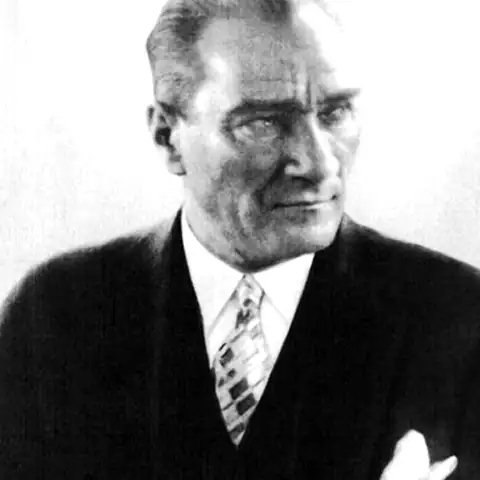
Mustafa Kemal Atatürk
Historical figureTurkey1881-1938

Mustafa Kemal Atatürk

Founder and 1st President of the Republic of Turkey (1923-1938) · Leader of the Turkish War of Independence

Atatürk was the officer who won Turkey's war of independence and became the first president of the republic. He ruled a one-party state that pushed secularism, nationalism and fast reform.

Profile on 12 axesAll 12 documented
ECONOMYSTATESOCIETYWORLDOwnershipMarketsWelfareAuthoritySecurityStructureMoralityReligionTechnologyCultureTradeForeign
Where they stood

Mustafa Kemal Atatürk, axis by axis

  1. PublicPrivate

    His 1930s statism built state-owned firms alongside private business, giving a moderate lean toward public ownership.

  2. PlannedFree
  3. SharedSelf-reliant

    Not much points to a firm plan for a modern welfare state, so the score is near the middle.

  4. DemocraticStrong leader
  5. LibertyOrder
  6. LocalCentral
  7. ProgressiveTraditional

    Votes for women, a secular civil code and changes in dress were advanced for the 1920s and 1930s. By modern standards, though, his rule did not protect every personal freedom.

  8. SecularReligious
  9. EmbraceCaution
  10. MulticulturalNational identity
  11. GlobalProtected
  12. CooperationStrength

    He worked for peace with neighbors, took Turkey into the League of Nations and signed pacts with neighbors, yet insisted on full Turkish sovereignty. The score leans slightly toward cooperation.

Who was Mustafa Kemal Atatürk?

Salonika, an Ottoman city that is now Thessaloniki in Greece, was where Mustafa Kemal was born in 1881. He joined the army and won fame for his defense at Gallipoli in 1915. After 1919 he headed a nationalist movement in Anatolia. It beat the Greek army and forced the Allies to rewrite the postwar terms at Lausanne in 1923. Turkey was declared a republic that year, and he became its president. He ruled through the Republican People's Party, the only party allowed for most of his time in power, until he died in 1938. In 1934 a law gave him the surname Atatürk, which means Father of the Turks.

Political views

  • He did away with the sultanate and the caliphate and turned Turkey into a secular republic.Source: bbc.co.uk
  • He brought in European-style law codes and dress, a new calendar and a Latin alphabet in place of Arabic script.Source: bbc.co.uk
  • He backed freedom for women, including legal rights and the vote.Source: bbc.co.uk
  • He ran a one-party state that stayed in place, with few breaks, until 1945.Source: bbc.co.uk
  • In 1919 he began a nationalist movement in Anatolia to fight the peace terms the victorious Allies tried to impose.Source: bbc.co.uk
  • His foreign policy slogan was 'Peace at Home, Peace in the World'. Turkey entered the League of Nations in 1932.Source: mfa.gov.tr
  • He aimed to keep Turkey neutral and on good terms with its neighbors. Pacts followed, such as the Balkan Entente and the Saadabad Pact, both in 1934.Source: mfa.gov.tr
  • He settled arguments over Mosul, Hatay and the Straits by negotiation and arbitration, and he did not go to war.Source: mfa.gov.tr

Legacy

Turks honor Atatürk as the founder of their republic, and his principles, called Kemalism, shaped the constitution, the army and the schools for decades. Admirers say he built a modern, secular nation out of a fallen empire and advanced the rights of women. Critics point to one-party rule, curbs on religious practice and pressure on minorities to assimilate. Kurdish revolts were crushed by force. In Dersim in 1936-1939 the army killed thousands of Kurdish civilians, and the BBC reports a toll above 13,000. A Turkish prime minister apologized for the killings in 2011. Insulting Atatürk's memory is still a crime in Turkey, and his 1930s statism left a legacy of state banks and factories.

In their own words

“Peace at Home, Peace in the World”
Maxim first used by Atatürk in 1931, as cited by the Turkish Ministry of Foreign Affairs

How close are you to Mustafa Kemal Atatürk?

Take the 12 Axes test and see which historical figure is your political twin, axis by axis.

Take the test

Mustafa Kemal Atatürk: questions

Which party did Atatürk lead?

He founded the Republican People's Party, or CHP, in 1923. For most of his presidency it was the only legal party. It is still a major party in Turkey.

What does Kemalism mean?

Kemalism is the name for Atatürk's guiding ideas. Its six pillars are republicanism, nationalism, populism, statism, secularism and reformism. These ideas steered the Turkish state for most of the twentieth century.

Was Atatürk a dictator?

He ran a one-party state and held great personal power, and many historians call his rule authoritarian. His defenders say it was a necessary stage in building a modern republic.

Sources