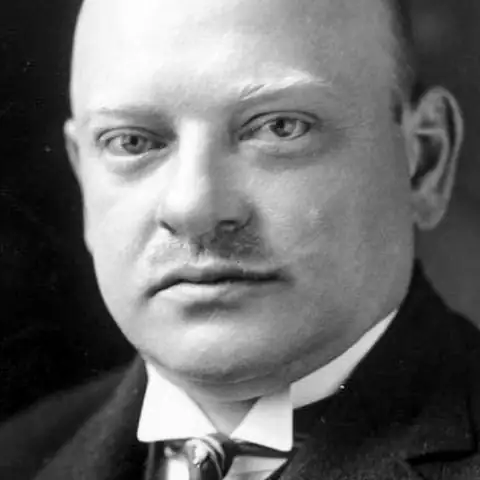
Who was Gustav Stresemann?
Gustav Stresemann grew up in Berlin, where his father sold beer. He studied economics and worked as a lawyer for industry groups in Saxony. He joined the National Liberals, won a Reichstag seat in 1907 and became party leader in 1917. After Germany's defeat he set up the German People's Party, a right-of-centre liberal force. He was chancellor for roughly a hundred days in 1923, leading a broad coalition. From then until he died in 1929 he was foreign minister in one cabinet after another. In 1926 he shared the Nobel Peace Prize with the French statesman Aristide Briand.
Political views
- In the First World War he backed German territorial gains and unrestricted submarine warfare, and he later opposed the Treaty of Versailles.Source: nobelprize.org
- As a young deputy he supported more social legislation, which put him at odds with the right wing of his party.Source: dhm.de
- He took the view that employers should accept the right of workers to organize and bargain together.Source: nobelprize.org
- As chancellor in 1923 he called off passive resistance to the occupation of the Ruhr, and a new currency ended the runaway inflation.Source: dhm.de
- He worked on the 1924 Dawes Plan, which eased the burden of reparations payments.Source: dhm.de
- He started the talks behind the 1925 Locarno agreements, in which Germany, France and Belgium gave up changing their shared borders by force.Source: dhm.de
- In 1926 he won Germany a place in the League of Nations.Source: nobelprize.org
Legacy
Admirers rank Stresemann as the ablest statesman of the Weimar years. They credit him with steadying the money and bringing Germany back into European affairs by talks instead of threats, and the Nobel Committee honored his Locarno work. Nationalists of his day attacked him for accepting the western borders and the reparations deals. Historians add that he had pushed for conquest during the war, stayed a monarchist at heart and hoped Poland's money troubles would let Germany change its border without a fight. He died in 1929, just before the Depression, and many see that as a heavy blow to the republic.
In their own words
“Locarno may be interpreted as signifying that the States of Europe at last realize that they cannot go on making war upon each other without being involved in common ruin.”