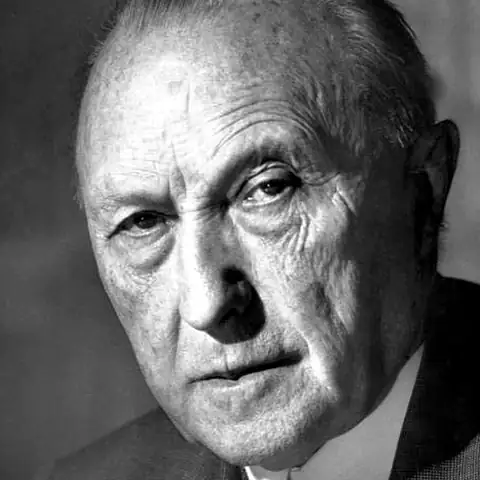
Who was Konrad Adenauer?
Konrad Adenauer began in the Catholic Centre Party and ran the city of Cologne as its mayor. The Nazis sacked him in 1933 after he would not decorate the city for a Hitler visit. The Gestapo jailed him following the July 1944 bomb plot. When the war ended he helped found the CDU, a party meant to bring Catholics and Protestants together. He chaired the council that wrote the Basic Law. In 1949 he became chancellor of the Federal Republic, elected by a single vote. He held the post until 1963 and also acted as his own foreign minister for four years in the 1950s.
Political views
- He wanted the CDU to bring Catholic and Protestant Germans into one Christian democratic party.Source: en.wikipedia.org
- He anchored West Germany in the Western camp, first with the European Coal and Steel Community and then the 1952 Germany Treaty. Full sovereignty followed in 1955.Source: hdg.de
- He supported rebuilding a German army and joining NATO. He would not accept East Germany as a state, or the Oder-Neisse frontier.Source: hdg.de
- He supported the 1957 Treaty of Rome, believing a united Europe was the surest route to lasting peace.Source: european-union.europa.eu
- In 1952 he signed the Luxembourg Agreement, under which Germany paid compensation to Israel.Source: european-union.europa.eu
- He and Charles de Gaulle signed the 1963 treaty on friendship and cooperation between Germany and France.Source: hdg.de
- A 1955 visit to Moscow brought diplomatic relations with the Soviet Union and freedom for many German soldiers still held there.Source: hdg.de
Legacy
To his supporters, Adenauer built a stable democracy in West Germany. They say he made peace with France and Israel and was a founder of European integration. Critics, including many on the left in his day, said his firm Western line deepened the split of Germany. Historians also fault his government for its amnesty policies and for employing ex-Nazi officials. The 1962 Spiegel affair, which made five FDP ministers resign, is often seen as the worst moment of his years in power.
In their own words
“In past decades and centuries, coal and steel have played a destructive role in conflicts between the peoples of Europe, having been used to manufacture weapons. Let us hope coal and steel will now unite them in thinking and acting together.”