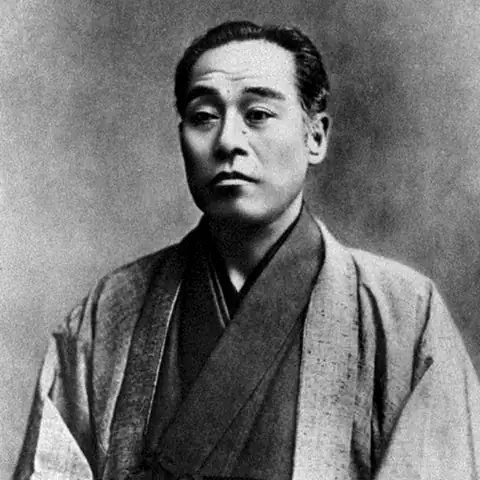
Who was Fukuzawa Yukichi?
Fukuzawa was born in Osaka in 1835, the son of a minor official serving the Nakatsu domain. His father died when he was young and he began schooling at 14. After the arrival of the US fleet in 1853 he studied Western subjects in Nagasaki, then joined Japanese missions to the United States in 1860 and to Europe in 1862. He founded Keio Gijuku, now Keio University, and wrote An Encouragement of Learning and Outline of a Theory of Civilization. He launched the newspaper Jiji Shimpo and died in 1901.
Political views
- He argued that Western prosperity came from technical progress, and that Japan needed a revolution in knowledge and thinking to match it.Source: keio.ac.jp
- In his first public essay in 1872 he argued that people are equal and that social distinctions come from education, so talent should rise regardless of birth.Source: keio.ac.jp
- He held that national independence depended on personal independence, and that self-reliant individuals would build a strong nation.Source: newworldencyclopedia.org
- He wrote in favor of women's equality and against the remaining practice of polygamy.Source: keio.ac.jp
- He admired Western nations for education, individualism, competition and the exchange of ideas, and favored parliamentary government and a national assembly.Source: newworldencyclopedia.org
- In the 1885 essay Datsu-A Ron he argued that Japan should move beyond its Asian neighbors and embrace Western civilization.Source: newworldencyclopedia.org
- He strongly supported the First Sino-Japanese War of 1894-1895, believing that Asian modernization could only be forced.Source: newworldencyclopedia.org
- Keio, which he founded, takes independence and self-respect as its basic spirit, a phrase tied to his writings.Source: keio.ac.jp
Legacy
Fukuzawa is honored as one of the founders of modern Japanese education and thought. Admirers credit him with spreading ideas of merit, equality of opportunity and independence, opening Keio to students from ordinary families, and popularizing public speaking and debate. His face appears on the 10,000-yen note. Critics point to Datsu-A Ron and his support for the Sino-Japanese War as ideas that helped justify Japanese expansion. He urged Japan to gain knowledge so that it could resist European imperialism.