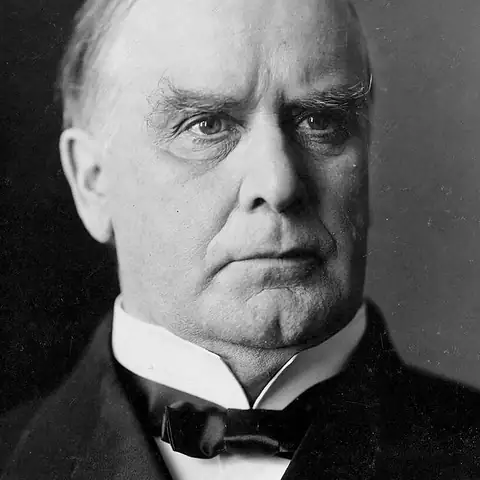
Who was William McKinley?
William McKinley joined the Union army as a private in the Civil War and left it as a major. He then practised law in Ohio and won seats in Congress and later the Ohio governorship. As head of the House Ways and Means Committee he drafted the 1890 tariff that bears his name. In 1896 he beat William Jennings Bryan in an election fought over gold and silver. In office he approved the Dingley Tariff and the Gold Standard Act. The war with Spain in 1898, fought over Cuba, left the US with Puerto Rico, Guam and the Philippines, where American troops then battled Filipino nationalists. Voters returned him in 1900. In September 1901 an anarchist shot him in Buffalo, and he died eight days later.
Political views
- In 1897 he signed the Dingley Tariff, which raised duties to shelter American industry and workers.Source: millercenter.org
- The Gold Standard Act of 1900, signed by him, tied the dollar firmly to gold.Source: millercenter.org
- He separated good trusts from bad ones and put forward no new law against monopolies.Source: millercenter.org
- He led the country into the Spanish war of 1898, which ended with the US taking Puerto Rico, Guam and the Philippines.Source: millercenter.org
- He chose to keep the Philippines, and his government fought the Filipino forces who wanted independence.Source: history.state.gov
- The day before he was shot in 1901, he announced he favored reciprocal trade treaties.Source: millercenter.org
Legacy
Admirers say McKinley ended the bitter fights over money of the depression years, oversaw a time of prosperity and made the United States a world power. Some historians call him the first modern president for the way he managed the press and directed a war. Anti-imperialists of his day, among them Mark Twain, Andrew Carnegie and ex-president Benjamin Harrison, said taking colonies betrayed American ideals. The war against Filipino forces began in 1899 and lasted to 1902. It was far deadlier than the Spanish war. According to the Office of the Historian at the State Department, as many as 200,000 Filipino civilians died from violence, hunger and disease. Critics also say he did little against segregation and lynching in the South.