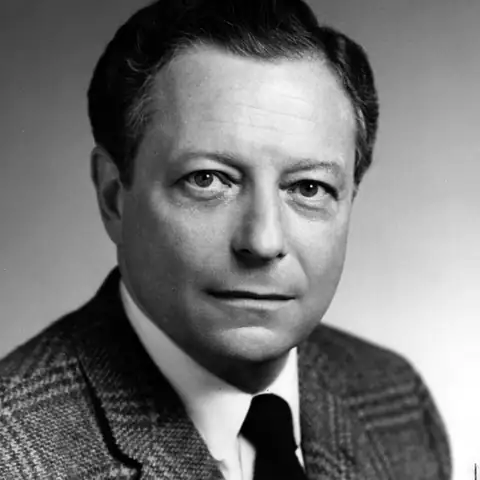
Who was Irving Kristol?
Irving Kristol was born in 1920 to Jewish immigrant parents in Brooklyn. He studied at the city's City College, where he joined a small Trotskyist group that opposed Stalin. He fought in Europe in the Second World War as an infantryman. Later he worked for Commentary, helped found the magazine Encounter in Britain and ran Basic Books. He started The Public Interest in 1965 to study how government programs can backfire, and The National Interest in 1985. He later lectured at NYU, wrote a regular column for the Wall Street Journal and was a fellow at the American Enterprise Institute. In 2002 he was given the Presidential Medal of Freedom. He died in 2009.
Political views
- Called neoconservatism a persuasion, not an ideology, and he defined a neoconservative with a quip: a liberal who has been mugged by reality.Source: en.wikipedia.org
- Favoured lower tax rates to spur steady economic growth, and he saw deficits as a short-term price worth paying for it.Source: aei.org
- Rejected most Great Society schemes, yet he could live with the smaller safety net left by the New Deal.Source: en.wikipedia.org
- Believed government has a legitimate part to play in the quality of schools, in questions of church and state, and in controlling pornography.Source: aei.org
- Wanted public and private institutions to foster patriotism, and warned that a world government could become a world tyranny.Source: aei.org
- Held that America ought to defend democracies when they are attacked, including Israel, and play the leading part on the world stage.Source: aei.org
- Ran The Public Interest as a place to show how liberal planning can produce harm nobody meant.Source: en.wikipedia.org
Legacy
Admirers say Kristol built the journals, think tanks and arguments that helped many disillusioned liberals join the conservative movement. They also credit him with promoting supply-side economics and with handing Republicans a governing outlook that tolerated a limited welfare state. In 1979 Esquire gave him the title godfather of neoconservatism. On the left, Michael Harrington used the word neoconservative as an insult, and Peter Steinfels wrote a 1979 book arguing it meant giving up on liberal reform. Traditional conservatives resented the group's rising influence, and the two camps clashed in the early 1980s when Mel Bradford's bid to lead the humanities endowment was blocked. Opponents of the 2003 Iraq War blamed neoconservative thinking for it. Encounter also drew scrutiny when its backing from the CIA came to light.
In their own words
“First, patriotism is a natural and healthy sentiment and should be encouraged by both private and public institutions.”