12axes-testTake the test
Wangari Maathai
Historical figureKE1940-2011

Wangari Maathai

Founder of the Green Belt Movement · Nobel Peace Prize laureate (2004)

Kenyan biologist who founded the Green Belt Movement, challenged the Moi government over land and democracy, won the 2004 Nobel Peace Prize and later served as a junior environment minister.

Profile on 12 axes9 of 12 documented
ECONOMYSTATESOCIETYWORLDOwnershipMarketsWelfareAuthoritySecurityStructureMoralityReligionTechnologyCultureTradeForeign
Where they stood

Wangari Maathai, axis by axis

  1. PublicPrivate

    She fought the handing of public parks and forests to private developers, which favors public stewardship.

  2. PlannedFree

    She opposed land grabs and tied environmental protection to livelihoods, but she also promoted women's economic independence through enterprise.

  3. SharedSelf-reliant

    She linked tree planting to poverty, food security and women's livelihoods.

  4. DemocraticStrong leader
  5. LibertyOrder
  6. LocalCentral
  7. 07MoralityNo clear record
    ProgressiveTraditional
  8. 08ReligionNo clear record
    SecularReligious
  9. EmbraceCaution

    She put protection of forests and ecosystems first, which sits toward caution. Her reported remarks on AIDS, which she partly denied, were controversial.

  10. MulticulturalNational identity
  11. 11TradeNo clear record
    GlobalProtected
  12. CooperationStrength

    She sought international pressure and prizes to back her campaigns and called for global responsibility for the planet. This leans toward cooperation, though foreign policy was not her focus.

3 axes have no clear record, so matching leaves them out.

Who was Wangari Maathai?

Wangari Maathai was born in 1940 in Nyeri, Kenya. She studied biology in the United States, earned a doctorate at the University of Nairobi in 1971 and became the first woman in East and Central Africa to do so. Through the National Council of Women of Kenya she began a tree-planting program that became the Green Belt Movement. In the 1990s she confronted President Daniel arap Moi over land and political prisoners and was attacked and detained. She won the Nobel Peace Prize in 2004, the first African woman to do so, and died in 2011.

Political views

  • Started tree planting through the National Council of Women of Kenya, which she chaired from 1981 to 1987, and women had reportedly planted over 20 million trees by the end of 1993.Source: rightlivelihood.org
  • Saw environmental protection as bound up with poverty, food security and livelihoods, and promoted women's leadership and economic independence.Source: rightlivelihood.org
  • Led a campaign against a planned 60-storey Times Media Complex in Uhuru Park, and the government dropped the project in February 1990.Source: nation.africa
  • Joined mothers of political prisoners in a 1992 hunger strike in Uhuru Park, where police violently dispersed the group and injured her. Moi called her a mad woman.Source: nation.africa
  • Led tree planting in Karura Forest in 1998 and 1999 against its allocation to private developers. Moi banned excision of the forest in August 1999 after international pressure.Source: nation.africa
  • Called for democratic governance, human rights and a bigger political role for women, and faced detention and persecution for defending a democratic, multi-ethnic Kenya.Source: rferl.org
  • Denied claims that she said HIV was created by Western scientists to harm Africans, calling such views wicked and destructive.Source: rferl.org

Legacy

Admirers honor Maathai as the first environmentalist and the first African woman to win the Nobel Peace Prize. The Green Belt Movement says it has helped plant more than 30 million trees, and her fights over Uhuru Park and Karura helped protect public land in Nairobi. She paid a personal price in beatings and detention. Critics note that media reports in 2004 quoted her suggesting HIV might be a laboratory product, remarks she partly disowned. In government she held only a junior post, as an assistant minister.

How close are you to Wangari Maathai?

Take the 12 Axes test and see which historical figure is your political twin, axis by axis.

Take the test

Wangari Maathai: questions

What was the Green Belt Movement?

A Kenyan grassroots program that began with women planting trees through the National Council of Women of Kenya. It links conservation to livelihoods, women's independence and democracy, and spread to other African countries.

Why did Wangari Maathai win the Nobel Peace Prize?

She won in 2004 for her work to restore African forests and protect the rights of women and children. She was the first African woman to win the prize, and the first environmentalist.

Did Wangari Maathai hold government office?

Yes. After the end of Moi's rule she served as a member of parliament and as an assistant minister for environment and natural resources. The Nation describes her as a former Tetu MP.

Sources

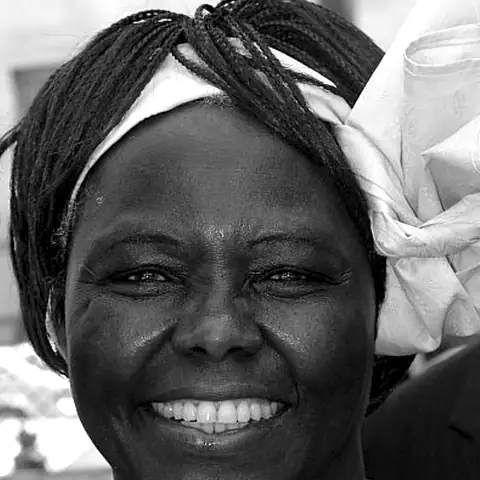
Portrait: Wangari Matthai 2001 (cropped).jpg by Kingkongphoto & www.celebrity-photos.com from Laurel Maryland, USA, CC BY-SA 2.0, via Wikimedia Commons. Cropped and converted to grayscale by 12axes-test.com.