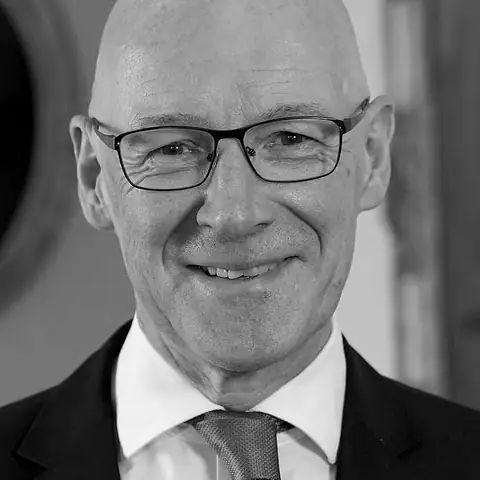
Who is John Swinney?
John Swinney joined the SNP in 1979 and was elected to both the House of Commons and the new Scottish Parliament in the late 1990s. He led the SNP from 2000 to 2004. When the party took office in 2007 he became Finance Secretary, and he later served as Deputy First Minister under Nicola Sturgeon, holding the education and Covid recovery briefs. He returned as SNP leader and became First Minister in May 2024 after Humza Yousaf resigned. At the May 2026 Holyrood election the SNP won 58 of 129 seats, short of a majority, and on 19 May 2026 Parliament re-elected him First Minister after three rounds of voting.
Previously: Deputy First Minister of Scotland (2014-2023) · Cabinet Secretary for Finance (2007-2016) · Leader of the Scottish National Party (2000-2004) · MSP for Tayside North, later Perthshire North (since 1999)
Documented positions
- Campaigns for Scottish independence and says an SNP majority would lay the path to a new referendum.Source: snp.org
- Supports an independent Scotland rejoining the European Union, arguing that Brexit has harmed Scotland.Source: snp.org
- Describes eradicating child poverty as his top priority and fully mitigates the bedroom tax in Scotland.Source: snp.org
- Pledged in 2026 to keep prescriptions and personal and nursing care free and to open seven-day GP walk-in clinics.Source: snp.org
- Pledged funded childcare to the end of primary school, a £2 bus fare cap and a price cap on a basket of essential foods.Source: snp.org
- Supports a defence policy centred on conventional forces for an independent Scotland and full membership of NATO.Source: snp.org
- Calls for an immigration policy tailored to Scotland's needs instead of a single UK-wide approach.Source: snp.org
Record
As Finance Secretary, Swinney managed Scotland's budgets through the years after the 2008 financial crisis and the 2014 independence referendum. As First Minister he met US President Donald Trump twice in 2025, pressing for whisky to be exempted from US tariffs and raising Gaza. In July 2026 Prime Minister Andy Burnham told him a new independence referendum was off limits; Swinney said he still had a mandate. In October 2026 opposition parties said he had misled Parliament by saying Scots would lose their pensions under Burnham's triple lock changes; he stood by his remarks and said the independent advisers on the Ministerial Code had concluded no investigation was required.
Supporters cite free services and child poverty measures. Critics point to the loss of six seats in 2026 and pressure on public services.