12axes-testTake the test
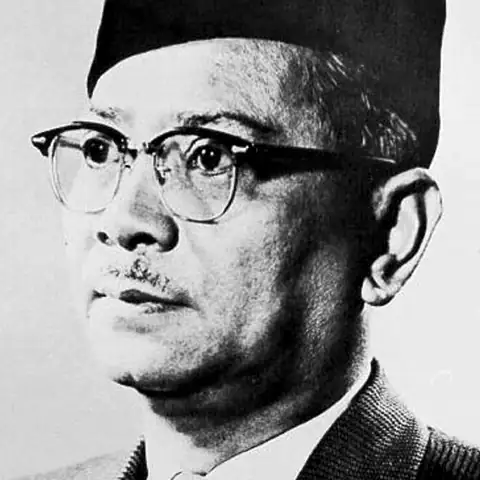
Tunku Abdul Rahman
Historical figureMY1903-1990

Tunku Abdul Rahman

First Prime Minister of independent Malaya and then Malaysia (1957-1970) · President of UMNO (1951-1971)

Malaya's first prime minister, who won independence by negotiation, built a multiethnic Alliance of Malay, Chinese and Indian parties, formed Malaysia in 1963, and agreed to Singapore's exit in 1965.

Profile on 12 axes6 of 12 documented
ECONOMYSTATESOCIETYWORLDOwnershipMarketsWelfareAuthoritySecurityStructureMoralityReligionTechnologyCultureTradeForeign
Where they stood

Tunku Abdul Rahman, axis by axis

  1. PublicPrivate

    The Alliance government largely kept the open, export-based economy it inherited and did not nationalize industry.

  2. PlannedFree

    Malaya relied on rubber, timber and other raw-material exports with little planning.

  3. 03WelfareNo clear record
    SharedSelf-reliant
  4. DemocraticStrong leader

    He won independence by elections and negotiation and led a coalition of ethnic parties. He still ran a dominant-party system and the 1969 emergency suspended Parliament.

  5. 05SecurityNo clear record
    LibertyOrder
  6. 06StructureNo clear record
    LocalCentral
  7. 07MoralityNo clear record
    ProgressiveTraditional
  8. SecularReligious

    He said the country was not an Islamic state, and the Alliance described Islam's constitutional status as largely ceremonial. Islam is still the federation's official religion.

  9. 09TechnologyNo clear record
    EmbraceCaution
  10. MulticulturalNational identity

    He built a multiethnic coalition yet backed special quotas for Malays and refused equal citizenship terms for Singapore. This is a communal compromise.

  11. 11TradeNo clear record
    GlobalProtected
  12. CooperationStrength

    He signed a defence pact with Britain and took a pro-Western line at first, then drifted toward neutrality and ties with communist states in the mid-1960s. He later joined regional groupings.

6 axes have no clear record, so matching leaves them out.

Who was Tunku Abdul Rahman?

Tunku Abdul Rahman was born in 1903 in Alor Setar, a son of the Sultan of Kedah. He studied at Cambridge, worked in the Kedah civil service and trained as a lawyer. In 1951 he became president of UMNO and joined it with Chinese and Indian parties in the Alliance, which swept the 1955 election. He then negotiated Malaya's independence, proclaimed on 31 August 1957, and became its first prime minister. In 1963 he oversaw the creation of Malaysia. He resigned in 1970 after the riots of May 1969 and died in 1990.

Political views

  • Sought independence by peaceful, constitutional means and said he wanted it without bloodshed.Source: biography.com
  • Led UMNO into an alliance with the Malayan Chinese Association in 1951 and the Malayan Indian Congress in 1955, winning 51 of 52 seats at the 1955 election.Source: pbs.org
  • Insisted that Malaysia was not an Islamic state, and the Alliance described Islam's place as the federation's religion as mainly ceremonial.Source: thejakartapost.com
  • The Alliance sought special quotas for Malays in civil service jobs, scholarships and education, which the constitution's drafters accepted subject to review after 15 years.Source: thejakartapost.com
  • Refused to give Singaporeans equal citizenship rights in Malaysia, fearing the effect on peninsular politics, and was alarmed by Lee Kuan Yew's call for a Malaysian Malaysia.Source: malaysianbar.org.my
  • Signed the separation agreement with Lee on 7 August 1965, believing that Malaysia's security was deteriorating daily.Source: malaysianbar.org.my
  • Leaned toward neutrality in foreign policy, which led to diplomatic ties with Yugoslavia, the Soviet Union, Romania and Bulgaria by the mid-1960s.Source: sare.um.edu.my

Legacy

Malaysians honor Tunku as the father of independence. Admirers credit him with reaching freedom without a war, keeping a Malay, Chinese and Indian coalition together and bringing Sabah and Sarawak into the federation. Critics say the Alliance's communal bargain entrenched ethnic politics and Malay quotas, and that he sent Singapore away rather than resolving the dispute. The 1969 election set back the Alliance, and riots followed in which many people died, most of them Chinese, according to PBS. He was pushed out within about a year, and the New Economic Policy favoring Malays was launched under his successor.

How close are you to Tunku Abdul Rahman?

Take the 12 Axes test and see which historical figure is your political twin, axis by axis.

Take the test

Tunku Abdul Rahman: questions

Why did Singapore leave Malaysia?

The split followed disputes over citizenship and Malay privileges, riots in Singapore in 1964 and Lee Kuan Yew's Malaysian Malaysia campaign. Tunku signed the separation agreement on 7 August 1965, saying the country's security was worsening daily.

Did Tunku Abdul Rahman want an Islamic state?

No. He said Malaysia was not an Islamic state, and the Alliance described Islam's constitutional status as mainly ceremonial. Islam remains the federation's official religion.

Why is Tunku Abdul Rahman called the father of independence?

He led the Alliance to its 1955 election win, negotiated self-government in 1956 and proclaimed Malaya's independence on 31 August 1957, then became its first prime minister.

Sources