12axes-testTake the test
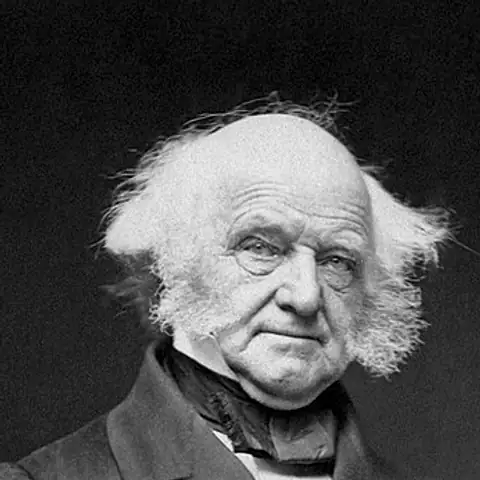
Martin Van Buren
Historical figureUnited States1782-1862

Martin Van Buren

8th President of the United States (1837-1841) · Vice President of the United States

The eighth president and the man who built the Democratic Party machine, he met the Panic of 1837 with a hands-off stance, set up the Independent Treasury and carried out the Cherokee removal.

Profile on 12 axes7 of 12 documented
ECONOMYSTATESOCIETYWORLDOwnershipMarketsWelfareAuthoritySecurityStructureMoralityReligionTechnologyCultureTradeForeign
Where they stood

Martin Van Buren, axis by axis

  1. PublicPrivate
  2. PlannedFree

    His Independent Treasury would split federal funds from private banks, and he thought government did best when it stayed out of private business.

  3. SharedSelf-reliant

    During the Panic of 1837 he refused federal relief, saying government should not make good private losses.

  4. DemocraticStrong leader

    He helped create the party system and argued that organized parties and competition check power, so he scores toward the democratic side.

  5. 05SecurityNo clear record
    LibertyOrder

    Nothing in the sources used here covers civil liberties or policing, so the axis is empty.

  6. LocalCentral

    He read the Constitution narrowly. That led him to reject a national bank and federally funded internal improvements.

  7. 07MoralityNo clear record
    ProgressiveTraditional

    Beyond the habits of his time, no stance on family or social norms is recorded, so it is empty.

  8. 08ReligionNo clear record
    SecularReligious

    Nothing in the sources used here covers religion in public life, so it is empty.

  9. 09TechnologyNo clear record
    EmbraceCaution

    No view is recorded, and the 19th-century setting offers little to go on.

  10. 10CultureNo clear record
    MulticulturalNational identity

    The sources used here show no stance on immigration, so the axis is empty.

  11. GlobalProtected

    In the Senate he voted for the protective 1828 tariff, yet his party was moving toward lower duties, and tariffs hardly mattered during his presidency. The score is near the middle.

  12. CooperationStrength

    He kept the peace with Britain during the Caroline affair and the Maine border dispute. In 1837 he also turned down Texas annexation, partly to avoid a war with Mexico.

5 axes have no clear record, so matching leaves them out.

Who was Martin Van Buren?

Van Buren climbed through New York politics as head of the Albany Regency, a tightly run party organization. He then helped put together the coalition that carried Andrew Jackson to the White House, and Jackson made him his secretary of state, then his running mate. He won the presidency in 1836. A few weeks after he took office the Panic of 1837 struck and a long depression followed, so much of his term went on pushing for an Independent Treasury to keep public money away from private banks. William Henry Harrison beat him in 1840. In 1848 he came back as the Free Soil candidate, opposing slavery in the lands of the West.

Political views

  • He told Congress in 1837 that the government should not offer special help for private losses caused by the panic.Source: millercenter.org
  • He led the building of the party machine that carried Andrew Jackson to office, and so helped shape the two-party system in America.Source: millercenter.org
  • He pressed for an Independent Treasury, a separate place for federal funds away from private banks. Congress agreed in 1840.Source: millercenter.org
  • His administration carried out the Cherokee removal known as the Trail of Tears and kept fighting the Seminoles in Florida.Source: millercenter.org
  • He chose not to act on annexing Texas, fearing a national fight over slavery in the western lands.Source: millercenter.org
  • In 1848 he stood for president again, this time for the Free Soil party, which fought the extension of slavery.Source: millercenter.org

Legacy

Scholars say Van Buren built the first national mass party, and he left the argument that open rivalry between organized parties strengthens democracy. Believers in small government admire his refusal to rescue banks or speculators, and the Independent Treasury, which outlasted a repeal and ran into the 1900s. Critics say his rigid response deepened hardship after 1837. The forced march of the Cherokee in 1838-1839, remembered as the Trail of Tears, happened on his watch, and some 3,000 to 4,000 Cherokees are thought to have died. The costly Seminole war also went on. For most of his career he also backed slaveholders' rights, to keep Southern Democrats on side, until the 1848 Free Soil run.

In their own words

“They wisely judged that the less government interferes with private pursuits the better for the general prosperity.”
Special Session Message to Congress, 1837

How close are you to Martin Van Buren?

Take the 12 Axes test and see which historical figure is your political twin, axis by axis.

Take the test

Martin Van Buren: questions

Was Martin Van Buren a Democrat?

Yes. He was one of the main organizers of the Democratic Party and served under Andrew Jackson. In 1848, though, he left to run on the antislavery Free Soil ticket.

What was the Independent Treasury?

This was Van Buren's idea of keeping public money in government vaults, not in private banks. Congress approved it in 1840, repealed it, and later brought it back.

How did Martin Van Buren handle the Panic of 1837?

He held that the government should not repay private losses, and he pressed for the Independent Treasury. Critics say this made the depression harder on ordinary people.

Sources