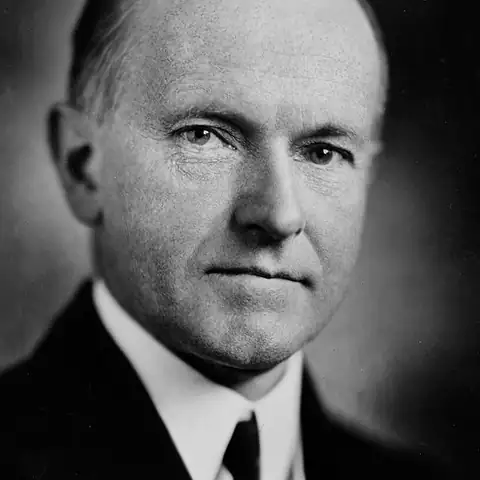
Who was Calvin Coolidge?
Calvin Coolidge was a Republican from Vermont who built his career in Massachusetts. He served as governor there and then as vice president to Warren G. Harding. When Harding died in 1923, Coolidge became president. Voters elected him in his own right in 1924, and he decided not to run in 1928. He was a quiet, careful man. During years of fast economic growth he pushed for lower taxes, smaller federal spending and light regulation of business. On most domestic questions he left the lead to Congress and the states.
Political views
- The Revenue Acts passed under him in 1924 and 1926 lowered income tax rates, and he treated tax cuts as his top domestic aim.Source: millercenter.org
- He ran budget surpluses and paid down the national debt, and he vetoed two veterans' bonus bills to keep spending down.Source: millercenter.org
- He believed that business prospers best when government regulates it lightly.Source: millercenter.org
- He opposed the McNary-Haugen plan, which would have had a government body buy up surplus crops to hold prices up.Source: millercenter.org
- In 1924 he put his name to a law that set tight immigration quotas for southern and eastern Europeans and barred Japanese immigrants.Source: millercenter.org
- The United States stayed out of the League of Nations under him. He did back US entry to the World Court, and he signed the Kellogg-Briand Pact, a treaty to renounce war.Source: millercenter.org
Legacy
Fans, especially fiscal conservatives, praise Coolidge for lower taxes, balanced budgets and a modest use of federal power in the boom years of the 1920s. Several recent biographies have brought new attention to him. Critics say that weak oversight of banks and stock markets, and his refusal to back farm relief, fed the problems behind the crash of 1929 and the long slump after it. Others fault him for a mild response to the Ku Klux Klan march in Washington in 1925 and for backing the strict 1924 immigration law.
In their own words
“After all, the chief business of the American people is business. They are profoundly concerned with producing, buying, selling, investing and prospering in the world.”