12axes-testTake the test
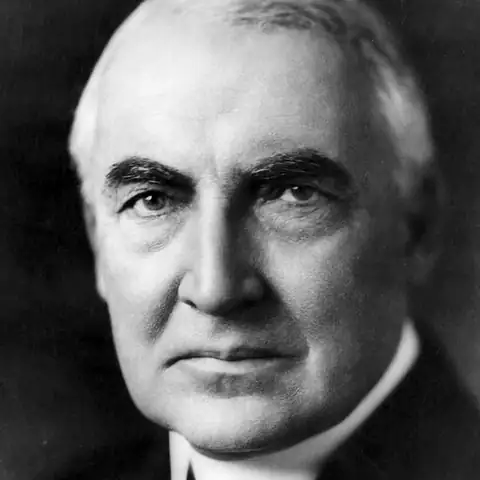
Warren G. Harding
Historical figureUnited States1865-1923

Warren G. Harding

29th President of the United States (1921-1923) · U.S. Senator from Ohio

Ohio newspaper publisher who won the presidency in 1920 on a promise of 'normalcy', cut taxes, raised tariffs and left office in the shadow of the Teapot Dome scandal.

Profile on 12 axes8 of 12 documented
ECONOMYSTATESOCIETYWORLDOwnershipMarketsWelfareAuthoritySecurityStructureMoralityReligionTechnologyCultureTradeForeign
Where they stood

Warren G. Harding, axis by axis

  1. PublicPrivate

    His instinct was for a government that worked hand in hand with business and private enterprise.

  2. PlannedFree

    After the wartime controls of the Wilson era, he let antitrust cases lapse and backed a pro-business agenda.

  3. SharedSelf-reliant

    Tax cuts for the rich and for firms, as Mellon proposed, had his support, though he also signed a budget law meant to restrain spending.

  4. DemocraticStrong leader

    He treated the presidency as a limited job that gave way to Congress and the cabinet, so the score leans democratic.

  5. LibertyOrder

    He freed political prisoners jailed under wartime laws, Eugene Debs among them, and was mostly relaxed about civil liberties.

  6. 06StructureNo clear record
    LocalCentral

    The sources used show no stance on federal versus state power, so the axis is null.

  7. 07MoralityNo clear record
    ProgressiveTraditional

    The sources used show no stance on family or social norms, so the axis is null.

  8. 08ReligionNo clear record
    SecularReligious

    The sources used show no stance on religion in public life, so the axis is null.

  9. 09TechnologyNo clear record
    EmbraceCaution

    No view on technology policy is recorded for this early 20th-century setting.

  10. MulticulturalNational identity

    A 1921 law capping immigration by national origin got his signature, even though he also spoke in the South for racial equality.

  11. GlobalProtected

    His 1922 signature on the Fordney-McCumber Tariff reversed Wilson's cuts.

  12. CooperationStrength

    America stayed out of the League of Nations, but he convened the Washington naval talks to limit fleets. The score sits at the middle.

4 axes have no clear record, so matching leaves them out.

Who was Warren G. Harding?

Before politics, Warren G. Harding ran a newspaper in Marion, Ohio. He went on to be Ohio's lieutenant governor and a US senator, and in 1920 he emerged from a deadlocked Republican convention as the compromise pick. Speaking from his front porch, he promised 'normalcy' after the First World War and the League of Nations fight, and won by a landslide. His cabinet included able men such as Charles Evans Hughes, Andrew Mellon and Herbert Hoover, but also friends from politics, and several of those turned out to be corrupt. He died suddenly in San Francisco in August 1923, before the scale of the scandals was clear.

Political views

  • Backed Treasury Secretary Andrew Mellon's plan for large tax cuts that helped the rich and corporations most.Source: millercenter.org
  • Signed a 1921 law that for the first time had the president send Congress one federal budget.Source: millercenter.org
  • Supported the Fordney-McCumber Tariff, which undid the lower rates of the Wilson years.Source: millercenter.org
  • Backed the 1921 quota law that capped each country's yearly immigration by national origin.Source: millercenter.org
  • Freed several people jailed under wartime laws once their cases were reviewed one by one, among them Socialist leader Eugene Debs.Source: millercenter.org
  • Gave a 1921 speech in Birmingham, Alabama, to a segregated crowd, urging political and economic equality for Black Americans.Source: en.wikipedia.org
  • Hosted a 1921-1922 conference in Washington that put limits on the fleets of the great powers.Source: millercenter.org

Legacy

For decades historians placed Harding at or close to the bottom of presidential rankings, chiefly because of corrupt appointees. Interior Secretary Albert Fall went to prison for taking bribes over oil leases at Teapot Dome, and the head of the Veterans Bureau cheated veterans' hospitals. Critics add that he led weakly and that his tax and tariff choices favoured the rich. Some historians now judge him more kindly. They credit the budget system, the naval arms treaties, the release of wartime prisoners and his open words on race. His support for national-origin immigration quotas is widely condemned today.

How close are you to Warren G. Harding?

Take the 12 Axes test and see which historical figure is your political twin, axis by axis.

Take the test

Warren G. Harding: questions

Which party did Warren G. Harding belong to?

He was a Republican. He served as a US senator from Ohio before winning the presidency for the party in 1920.

What was the Teapot Dome scandal?

It was a bribery scandal in which Interior Secretary Albert Fall leased federal oil reserves in return for payments. Fall went to prison. It came out after Harding's death and hurt his reputation.

What did 'return to normalcy' mean?

It was Harding's 1920 slogan for calming politics after the First World War. It meant lower taxes, less government activity at home, and no entry into the League of Nations.

Sources