12axes-testTake the test
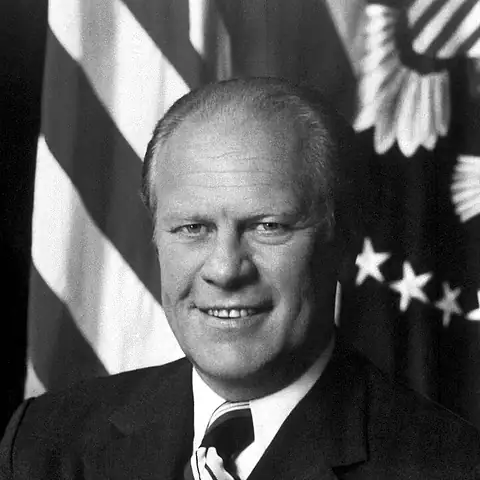
Gerald Ford
Historical figureUnited States1913-2006

Gerald Ford

38th President of the United States (1974-1977) · Vice President of the United States

America's 38th president, the only man to hold the office without winning a national election, who followed Nixon, pardoned him and faced high inflation and the end of the Vietnam War.

Profile on 12 axes9 of 12 documented
ECONOMYSTATESOCIETYWORLDOwnershipMarketsWelfareAuthoritySecurityStructureMoralityReligionTechnologyCultureTradeForeign
Where they stood

Gerald Ford, axis by axis

  1. PublicPrivate

    A mainstream Republican of his time who favoured private business and lower taxes.

  2. PlannedFree

    Turned down Nixon's wage and price controls and pushed to lift controls on oil prices.

  3. SharedSelf-reliant

    Vetoed many spending bills and said tax cuts should come with restraint in spending.

  4. DemocraticStrong leader

    Pledged to win back public trust after Watergate and accepted the limits Congress placed on him. Critics argued that the Nixon pardon set a former president above the law.

  5. LibertyOrder

    Gave draft evaders and deserters from the Vietnam years a route back to normal life, with conditions attached.

  6. LocalCentral

    Resisted a federal bailout for New York City in 1975 before agreeing to federal loans. Scored mildly toward local control.

  7. ProgressiveTraditional

    Spoke up for the Equal Rights Amendment, but disliked Roe v. Wade and thought states should decide on abortion. This puts him near the middle.

  8. 08ReligionNo clear record
    SecularReligious

    The sources used show no plan for religion in public life, so this axis is null.

  9. 09TechnologyNo clear record
    EmbraceCaution

    The sources used show no stance on technology policy, so this axis is null.

  10. MulticulturalNational identity

    Signed the 1975 law that brought about 130,000 Vietnamese refugees to the United States.

  11. 11TradeNo clear record
    GlobalProtected

    The sources used show no firm stance on trade, so this axis is null.

  12. CooperationStrength

    Kept up detente with the Soviet Union, signed the Helsinki Accords and agreed the Vladivostok arms framework, yet he used force in the Mayaguez incident.

3 axes have no clear record, so matching leaves them out.

Who was Gerald Ford?

Gerald Ford was born in 1913. He played football at the University of Michigan, studied law at Yale and served in the Navy during the Second World War. Voters in Grand Rapids sent him to Congress in 1948, and by 1965 he led the Republicans in the House. When Spiro Agnew resigned in 1973, Richard Nixon named Ford vice president. Nixon resigned in August 1974 and Ford took over. His pardon of Nixon a month later hurt his standing. He then struggled with rising prices and joblessness and with a Democratic Congress. He lost narrowly to Jimmy Carter in 1976.

Political views

  • Gave Richard Nixon a full pardon in September 1974 for any crimes he might have committed in office.Source: millercenter.org
  • Started the Whip Inflation Now campaign and later asked for a tax cut to lift the economy, while vetoing many spending bills.Source: millercenter.org
  • Set up a clemency program for draft evaders and deserters from the Vietnam era.Source: en.wikipedia.org
  • Backed the Equal Rights Amendment, and wanted a constitutional amendment that would leave abortion to each state.Source: en.wikipedia.org
  • Signed the 1975 Helsinki Accords, which accepted postwar European borders and committed the signers to human rights.Source: millercenter.org
  • Supported the resettlement of Vietnamese refugees in America under a 1975 law.Source: en.wikipedia.org

Legacy

Many credit Ford with bringing calm and honesty back to the White House after Watergate, and his reputation has improved with time. The Nixon pardon was very unpopular and probably cost him the 1976 election, though some early critics, including Senator Edward Kennedy, later said it helped the country move on. Opponents say his economic policies failed to cure stagflation and that his many vetoes caused deadlock with Congress. Conservatives led by Ronald Reagan attacked detente and the Helsinki Accords. Critics also fault his administration for backing Indonesia's 1975 invasion of East Timor.

How close are you to Gerald Ford?

Take the 12 Axes test and see which historical figure is your political twin, axis by axis.

Take the test

Gerald Ford: questions

Was Gerald Ford a conservative?

Ford was a mainstream Republican, closer to the party's moderate wing. He backed lower taxes and fewer controls, but also supported the Equal Rights Amendment and refugee resettlement.

Why did Ford pardon Nixon?

Ford said a long trial of the ex-president would drag out Watergate and stop the country from healing. Some critics suspected a secret deal. Ford denied this when he testified to a House committee.

Did Gerald Ford win an election as president?

He won the Republican nomination in 1976 but lost the general election to Jimmy Carter. He was never elected president or vice president, since Congress confirmed him as vice president in 1973.

Sources