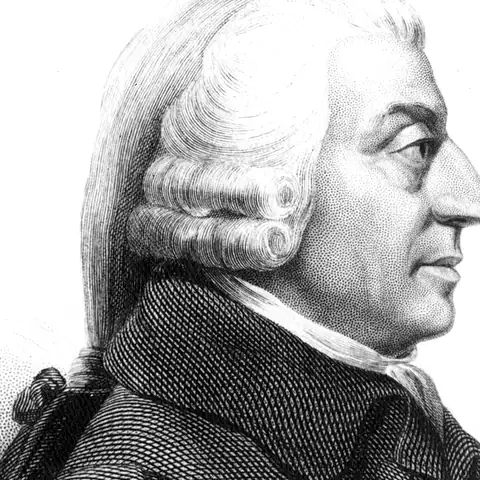
Who was Adam Smith?
Adam Smith grew up in Kirkcaldy, Scotland, and studied at Glasgow and Oxford before teaching moral philosophy at Glasgow. In 1759 he published The Theory of Moral Sentiments, which says that people judge right and wrong by imagining how a fair observer would see their acts. He later travelled in France as tutor to a young duke. Back home, he spent years on his great work on how nations grow rich, which appeared in 1776. In his last years he worked as a customs official in Edinburgh. He is a leading name of the Scottish Enlightenment and is often seen as the first major economist.
Political views
- Wrote that when governments drop all favours and restraints, a simple order of natural liberty grows up by itself.Source: gutenberg.org
- Attacked the mercantile system, with its tariffs, monopolies and colonial trade rules, as a drag on a nation's wealth.Source: plato.stanford.edu
- Said the state's main jobs were defence, justice, and a small set of public works and institutions.Source: iep.utm.edu
- Backed publicly funded parish schools, cheap enough that ordinary working families could pay for a basic education.Source: gutenberg.org
- Observed that merchants in one trade rarely gather without the talk turning to a plan to push up prices.Source: gutenberg.org
- Made an exception to free trade for the Navigation Acts, arguing that national defence counts for more than wealth.Source: gutenberg.org
- Praised the gains from dividing labour, but feared that endless repetitive tasks could dull workers, a harm he wanted schooling to soften.Source: gutenberg.org
Legacy
Many call Smith the father of economics. Free-market thinkers treat his big book as the founding case for competition and open borders for trade. Other readers point out that he also wrote about sympathy, fairness and the moral limits of business, and that he distrusted merchants as much as he distrusted kings. Some on the left use his sharp words about monopolies and the toll of factory-style work. Critics say his praise of self-interest was later bent to excuse inequality. Others reply that treating him as an all-out laissez-faire thinker skips over the exceptions he made, such as defence and schooling.
In their own words
“It is not from the benevolence of the butcher, the brewer, or the baker that we expect our dinner, but from their regard to their own interest.”