12axes-testTake the test
Friedrich Hayek
Historical figureAustria1899-1992

Friedrich Hayek

Economist and political philosopher · Professor at the London School of Economics, Chicago and Freiburg

Economist and philosopher from Vienna who held that prices carry knowledge no planner can collect, and that state planning puts personal freedom at risk.

Profile on 12 axesAll 12 documented
ECONOMYSTATESOCIETYWORLDOwnershipMarketsWelfareAuthoritySecurityStructureMoralityReligionTechnologyCultureTradeForeign
Where they stood

Friedrich Hayek, axis by axis

  1. PublicPrivate
  2. PlannedFree
  3. SharedSelf-reliant

    He accepted a basic income floor and some public services but rejected the idea of redistribution for social justice. That makes his welfare score moderate, not extreme.

  4. DemocraticStrong leader

    He backed constitutional democracy, but wanted firm limits on majority rule and distrusted legislatures with no checks. This score is a judgment call.

  5. LibertyOrder
  6. LocalCentral
  7. ProgressiveTraditional

    He mixed classical liberalism with a Burke-like respect for traditions that had evolved over time, so his social score sits near the middle.

  8. SecularReligious
  9. EmbraceCaution

    His target was scientism in the study of society, not technology itself. The score leans slightly toward embracing it.

  10. MulticulturalNational identity
  11. GlobalProtected
  12. CooperationStrength

    Scored from his general support for international order and law, not from any detailed foreign policy plan. This is a judgment call.

Who was Friedrich Hayek?

Friedrich Hayek was born in Vienna in 1899 and grew into a leading thinker of the Austrian school of economics. He taught in London, Chicago and Freiburg, and later took British citizenship. His 1944 bestseller, The Road to Serfdom, warned that running an economy from the centre wears away political freedom. Later books, including The Constitution of Liberty and Law, Legislation and Liberty, laid out his views on the rule of law and on orders that grow without a designer. In 1974 he shared the Nobel Prize in economics. He died in 1992.

Political views

  • Said prices pass on scattered, local knowledge that no central planner can gather, which is why fixed prices lead to gluts or shortages.Source: plato.stanford.edu
  • Saw markets, language and morals as orders that grow out of countless separate choices, not from any central design.Source: plato.stanford.edu
  • Wanted government to set steady, general rules and act like a referee, judging whether the process is fair rather than aiming at set results.Source: plato.stanford.edu
  • Was willing to accept a minimum income, state schools and basic public works, but rejected the idea that the state should pursue social justice in the sense of a fair spread of income.Source: plato.stanford.edu
  • Wanted constitutional limits that shield minorities from an unchecked majority, and feared that lawmaking attracts special-interest groups.Source: plato.stanford.edu
  • Used his Nobel lecture to warn against the pretence that social scientists can steer a complex economy the way engineers control a machine.Source: nobelprize.org

Legacy

Hayek's thinking shaped classical liberal and free-market movements. In the 1980s, leaders in Britain and the United States named him as an inspiration. Admirers say he gave a lasting explanation of why central planning fails and why the rule of law matters. Critics say he played down market failures and the need for social insurance. Some also see a tension between his support for a safety net and his rejection of social justice. Both conservatives and libertarians claim him, yet he called himself a liberal.

In their own words

“He will therefore have to use what knowledge he can achieve, not to shape the results as the craftsman shapes his handiwork, but rather to cultivate a growth by providing the appropriate environment, in the manner in which the gardener does this for his plants.”
The Pretence of Knowledge, Nobel Prize lecture, 1974

How close are you to Friedrich Hayek?

Take the 12 Axes test and see which historical figure is your political twin, axis by axis.

Take the test

Friedrich Hayek: questions

Was Hayek a conservative or a libertarian?

Neither label fits cleanly. Conservatives like his respect for old traditions and his dislike of planning, and libertarians like his case for markets. He called himself a classical liberal, and scholars still argue over where he belongs.

What did Hayek say in The Road to Serfdom?

He argued that full economic planning gives too much power to a few people and so threatens political and personal freedom. First published in 1944, it became one of the most read defences of the market economy.

Did Hayek reject the welfare state?

Not entirely. He backed a minimum income and some public services. What he opposed was using the state to shape how income is shared out.

Sources

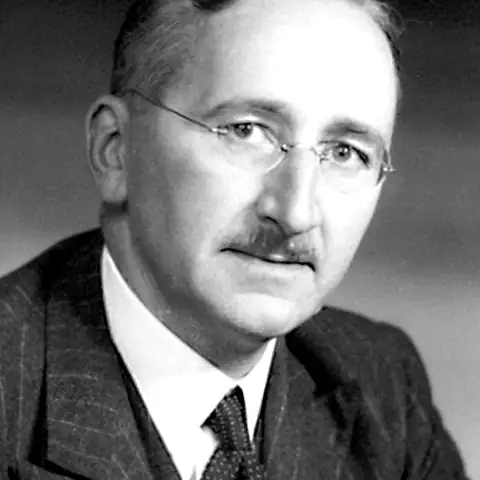
Portrait: Friedrich Hayek portrait.jpg by The original uploader was DickClarkMises at English Wikipedia, CC BY-SA 3.0, via Wikimedia Commons. Cropped and converted to grayscale by 12axes-test.com.