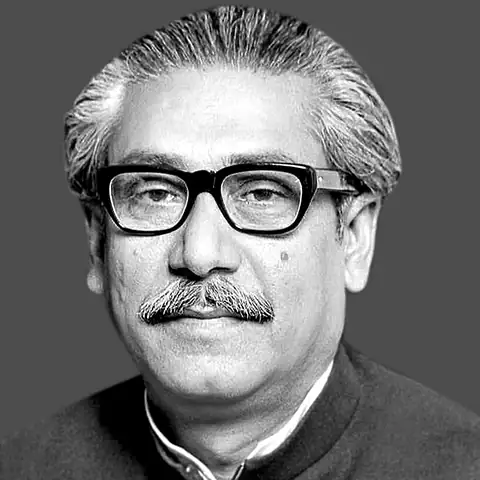
Who was Sheikh Mujibur Rahman?
Mujib was born in 1920 and became a student activist who was expelled from Dhaka University in 1948. He helped found the Awami League and became its president in 1966. That year he announced the Six Points, a plan for regional autonomy, and he spent long periods in jail. His party won the December 1970 elections, but Pakistan's rulers did not hand over power. After the army began its crackdown on 25 March 1971, he declared independence for Bangladesh and was held in West Pakistan. He returned in January 1972 and served first as prime minister, then from early 1975 as president. A group of army officers assassinated him on 15 August 1975.
Political views
- In February 1966 he announced the Six Points, which sought a federation with a parliamentary government, a directly elected legislature and a central government limited to defence, foreign affairs and currency.Source: thefridaytimes.com
- The Six Points also asked for separate foreign exchange accounts, taxation by the federating units, and a military or paramilitary force for East Pakistan.Source: thefridaytimes.com
- One tribute describes him as a confirmed democrat, a benign socialist, a liberal secularist and an uncompromising nationalist.Source: thefridaytimes.com
- In 1955 his party dropped 'Muslim' from its name and became the Awami League.Source: en.banglapedia.org
- In the December 1970 elections the Awami League won 167 of the 169 East Pakistan seats allotted to the National Assembly.Source: en.banglapedia.org
- A new constitution was adopted within about a year of the war, and his foreign policy was summed up as friendship to all and malice to none.Source: en.prothomalo.com
- On 24 February 1975 he brought all political parties under one party, the Bangladesh Krishak Sramik Awami League (BAKSAL), which was dissolved after his death.Source: en.prothomalo.com
Legacy
Admirers call Mujib the father of the nation and the leader whose Six Points and 1970 victory turned Bengali grievances into a mass movement that won independence in 1971. His courage under repeated arrest is part of the national story. Critics fault his last years in office. The war had left the country devastated, a famine struck in 1974, and law and order worsened. In response he created the Rakkhi Bahini security force and then, in 1975, a single-party system that ended open political competition. His killing in a coup, together with most of his family, left a bitter divide that still shapes Bangladeshi politics.