12axes-testTake the test
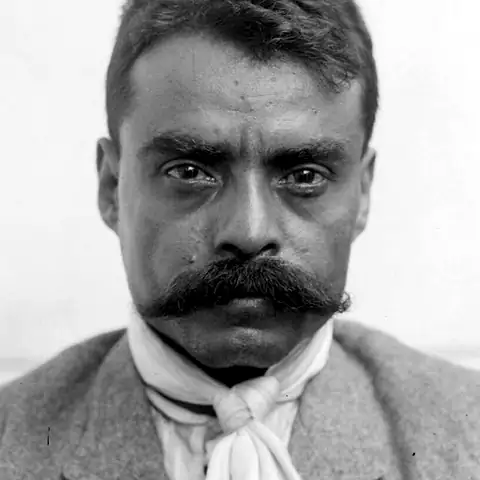
Emiliano Zapata
Historical figureMexico1879-1919

Emiliano Zapata

Leader of the Liberation Army of the South · Co-author of the Plan of Ayala (1911)

Peasant leader from Morelos who fought for the return of village land during the Mexican Revolution, broke with Madero over slow reform and issued the Plan of Ayala.

Profile on 12 axes6 of 12 documented
ECONOMYSTATESOCIETYWORLDOwnershipMarketsWelfareAuthoritySecurityStructureMoralityReligionTechnologyCultureTradeForeign
Where they stood

Emiliano Zapata, axis by axis

  1. PublicPrivate

    The Plan of Ayala asked for communal lands to be returned and hacienda land to be expropriated. The aim was village and small-holder land, not state ownership of industry.

  2. PlannedFree
  3. SharedSelf-reliant
  4. DemocraticStrong leader

    He answered to village assemblies and refused to attend a convention of unelected delegates, but he led an army as a chieftain.

  5. LibertyOrder

    He seized land by force and waged guerrilla war, yet no policing or civil-liberties program is on record.

  6. LocalCentral

    His movement began as a defense of one village's land claims and stayed rooted in Morelos.

  7. 07MoralityNo clear record
    ProgressiveTraditional
  8. 08ReligionNo clear record
    SecularReligious
  9. 09TechnologyNo clear record
    EmbraceCaution
  10. 10CultureNo clear record
    MulticulturalNational identity
  11. 11TradeNo clear record
    GlobalProtected
  12. 12Foreign policyNo clear record
    CooperationStrength

6 axes have no clear record, so matching leaves them out.

Who was Emiliano Zapata?

Emiliano Zapata was born in 1879 in Anenecuilco, Morelos, into a family that had long led its community. In 1909 villagers chose him to press their claims to communal land that estate owners had taken. He joined Francisco Madero's 1910 revolt against Porfirio Díaz, then turned against Madero when the land was not returned. In November 1911 he issued the Plan of Ayala. For the next decade he fought Madero's successors, first Victoriano Huerta and then the Constitutionalists under Venustiano Carranza, mostly in Morelos, at the head of the Liberation Army of the South. On April 10, 1919, he was shot in an ambush at Chinameca.

Political views

  • He campaigned for villagers' right to land that estate owners were taking, and he first used old title deeds to back the villages' claims.Source: libcom.org
  • When the government stalled, he began taking disputed land by force.Source: libcom.org
  • He broke with Madero after Madero insisted on institutional procedures, ordered Zapata's troops disarmed and failed to act on land to Zapata's satisfaction.Source: encyclopedia.com
  • The Plan of Ayala, issued on November 25, 1911, denounced Madero and called for communal lands to be returned and hacienda land to be expropriated, with no payment to owners who refused.Source: encyclopedia.com
  • He refused to attend Carranza's convention because none of its delegates had been elected.Source: libcom.org
  • A schoolteacher, Otilio Montaño, introduced him to the writings of Ricardo Flores Magón and Peter Kropotkin, and he was partly influenced by Magón, though readers dispute whether the anarchist label fits him.Source: libcom.org
  • Article 27 of the 1917 constitution drew on the Plan of Ayala, but large-scale land distribution waited until the government of Lázaro Cárdenas in the 1930s.Source: encyclopedia.com

Legacy

Zapata is one of Mexico's best-known revolutionary heroes, and his image stands for peasant land rights. Admirers credit him with keeping the land question at the center of the revolution, and the 1994 Zapatista uprising in Chiapas took up his name. Critics at the time, especially urban ones, called him the Attila of the South and treated him as a bandit. He fought an elected president in Madero, and his forces took land by force. After he was lured into an ambush and killed in 1919, the Liberation Army of the South gradually fell apart. Later leaders often pursued policies he would have opposed.

How close are you to Emiliano Zapata?

Take the 12 Axes test and see which historical figure is your political twin, axis by axis.

Take the test

Emiliano Zapata: questions

Was Emiliano Zapata an anarchist?

Not in any simple sense. A teacher introduced him to Ricardo Flores Magón and Kropotkin, and Magón influenced him in part, but his program was about returning village land, and historians dispute the anarchist label.

What was the Plan of Ayala?

A manifesto of November 25, 1911 that denounced Madero and demanded the return of communal lands and the expropriation of hacienda land, with no payment for owners who refused.

How did Emiliano Zapata die?

On April 10, 1919, Colonel Jesús Guajardo invited him to a meeting at the Chinameca hacienda and his men shot him. Accounts differ on how far Carranza's circle ordered the plot.

Sources