12axes-testTake the test
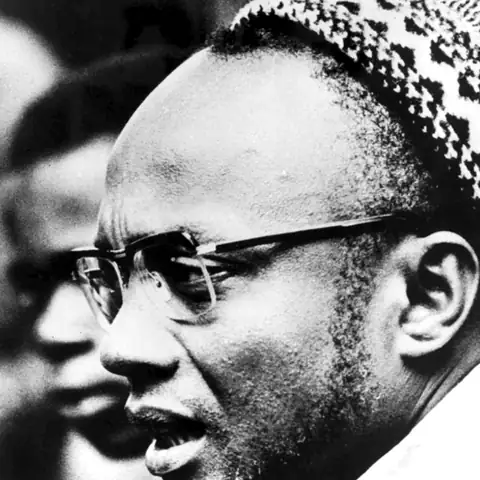
Amílcar Cabral
Historical figureGW1924-1973

Amílcar Cabral

Founder and leader of the PAIGC · Anticolonial theorist

Guinea-Bissau-born founder of the PAIGC who led the armed struggle against Portuguese rule and wrote on imperialism, class and culture as the base of national liberation. Dissidents killed him in 1973.

Profile on 12 axes7 of 12 documented
ECONOMYSTATESOCIETYWORLDOwnershipMarketsWelfareAuthoritySecurityStructureMoralityReligionTechnologyCultureTradeForeign
Where they stood

Amílcar Cabral, axis by axis

  1. PublicPrivate

    He said independent nations had two options, a return to imperialist domination or socialism, and wanted foreign control of productive forces ended.

  2. PlannedFree

    He treated liberation as freeing national productive forces from foreign control and saw state capitalism and neo-colonialism as the alternative to socialism.

  3. 03WelfareNo clear record
    SharedSelf-reliant
  4. DemocraticStrong leader

    He argued for a disciplined, politically conscious revolutionary organization. Yet he also warned against opportunist leaders and stressed contact with the masses. Mildly toward strong leadership.

  5. 05SecurityNo clear record
    LibertyOrder
  6. 06StructureNo clear record
    LocalCentral
  7. ProgressiveTraditional

    He told the movement to reject tribal mentality, gerontocracy, nepotism and the social inferiority of women.

  8. 08ReligionNo clear record
    SecularReligious
  9. 09TechnologyNo clear record
    EmbraceCaution
  10. MulticulturalNational identity

    He championed a return to African roots and opposed colonial assimilation, but also warned against uncritical praise of African culture. Mildly toward national identity.

  11. GlobalProtected

    Political independence meant little to him without ending foreign economic control of national resources and production.

  12. CooperationStrength

    He was a diplomat who made more than 80 visits to about twenty countries for aid and allies, but he also called armed struggle the normal path against imperialism.

5 axes have no clear record, so matching leaves them out.

Who was Amílcar Cabral?

Amílcar Cabral was born in Bafatá, Guinea-Bissau, on 12 September 1924 to a Cape Verdean father, and the family moved to Cape Verde when he was four. He studied agronomy in Portugal, graduating in 1952, and later surveyed 2,248 peasant holdings in Guinea-Bissau. He helped found the African Party for the Independence of Guinea and Cape Verde, the PAIGC, which tied the two territories together politically. He served as the party's chief diplomat, visiting about twenty countries to win aid. On 20 January 1973 he was shot dead outside his home in Conakry.

Political views

  • Defined imperialism as the pursuit of profit by monopoly financial capital, and said it denies a people's historical development by seizing its productive forces.Source: marxists.org
  • Argued that class struggle is not the universal motor of history, since peoples without classes still have history.Source: marxists.org
  • Described national liberation as a people regaining its historical personality by ending imperialist domination, and held that armed struggle is the normal path.Source: marxists.org
  • Warned that the petty bourgeoisie must commit suicide as a class and identify with workers and peasants, or betray the revolution.Source: marxists.org
  • Said independent nations could either return to imperialist domination or move toward socialism, led by a disciplined revolutionary organization.Source: marxists.org
  • Held that foreign rule can only be secured by suppressing a people's culture, and urged the movement to build on the culture of workers and peasants.Source: marxists.org
  • Called for rejecting tribal mentality, gerontocracy, nepotism and the social inferiority of women within the struggle.Source: marxists.org

Legacy

Admirers see Cabral as one of the leading theorists of African liberation, who joined Marxist analysis to the facts of colonial societies and who built wide international support for the PAIGC. Views of his leadership vary widely, and some in his own movement wanted a Guinea-Bissauan rather than a Cape Verdean-rooted leader. Dissidents led by Innocencio Kani killed him in 1973, and the encyclopedia entry notes that Portuguese forces under General Spinola aided this group in the hope of a settlement for Guinea-Bissau alone. His call for a revolutionary vanguard and for socialism as the only alternative to neo-colonialism remains debated.

How close are you to Amílcar Cabral?

Take the 12 Axes test and see which historical figure is your political twin, axis by axis.

Take the test

Amílcar Cabral: questions

Was Amílcar Cabral a Marxist?

He worked inside a Marxist framework but revised it for colonial societies, arguing that class struggle is not the universal engine of history and that imperialism blocks a people's own development.

What is class suicide?

Cabral used the phrase for the petty bourgeoisie. He said they must give up their class interests and identify with workers and peasants, or else betray the revolution and become a pseudo-bourgeoisie.

Who killed Amílcar Cabral?

He was shot on 20 January 1973 outside his home in Conakry by dissidents within the PAIGC led by Innocencio Kani. Portuguese forces reportedly aided the group.

Sources