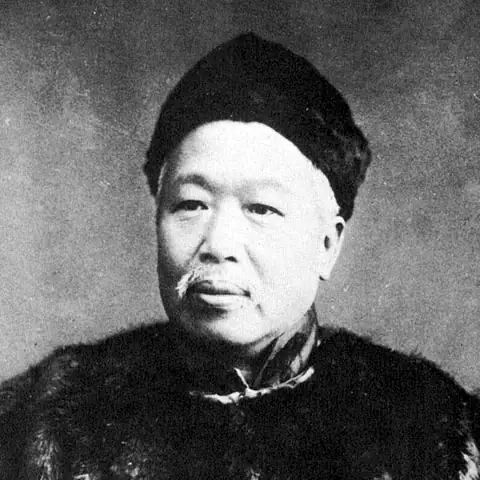
Who was Kang Youwei?
Kang Youwei was born in 1858 and became a Confucian scholar who argued that Confucius was a reformer. After China's defeat by Japan in 1895 he petitioned the Guangxu Emperor against the Treaty of Shimonoseki and organized reform societies. In June 1898 the emperor received him, and a series of decrees on schools, examinations, budgets and administration followed. Conservatives led by Empress Dowager Cixi ended the reforms on 21 September 1898, and Kang fled. He spent about fourteen years in exile, founded the Protect the Emperor Society in 1899, and backed a brief Qing restoration in 1917. He died in 1927.
Political views
- He argued that Confucius was a reformer and that many of the orthodox classics were forged, a radical reading of Confucianism.Source: encyclopedia.com
- He regarded constitutional monarchy as the right system for his age and republicanism as an ideal for a later age.Source: encyclopedia.com
- In June 1898 the emperor, advised by Kang, issued decrees on modern schools, civil service examinations, a budget system and office cuts.Source: ebsco.com
- His reform school taught Western subjects, and he saw Western thought and technology as central to human progress.Source: newworldencyclopedia.org
- He supported equality between men and women and worked to end foot-binding.Source: newworldencyclopedia.org
- He opposed the 1911 revolution and pressed to make Confucianism China's state religion, seeking warlord support for this as late as 1923.Source: ebsco.com
- In the Datong book he imagined a world under one central democratic government, with no private property and renewable one-year marriage contracts.Source: newworldencyclopedia.org
Legacy
Admirers in China remember Kang as a bold reformer who tried to modernize an empire before it was too late, and who pressed for schools, constitutional limits and women's rights. Critics say he was a contradictory figure. His utopian writing called for abolishing family and property, yet he spent his later years defending a dynasty and joining a failed plot to restore the Qing in 1917. By then most Chinese intellectuals saw him as a relic. Historians disagree on his legacy, and one portrays him as an opportunist.